
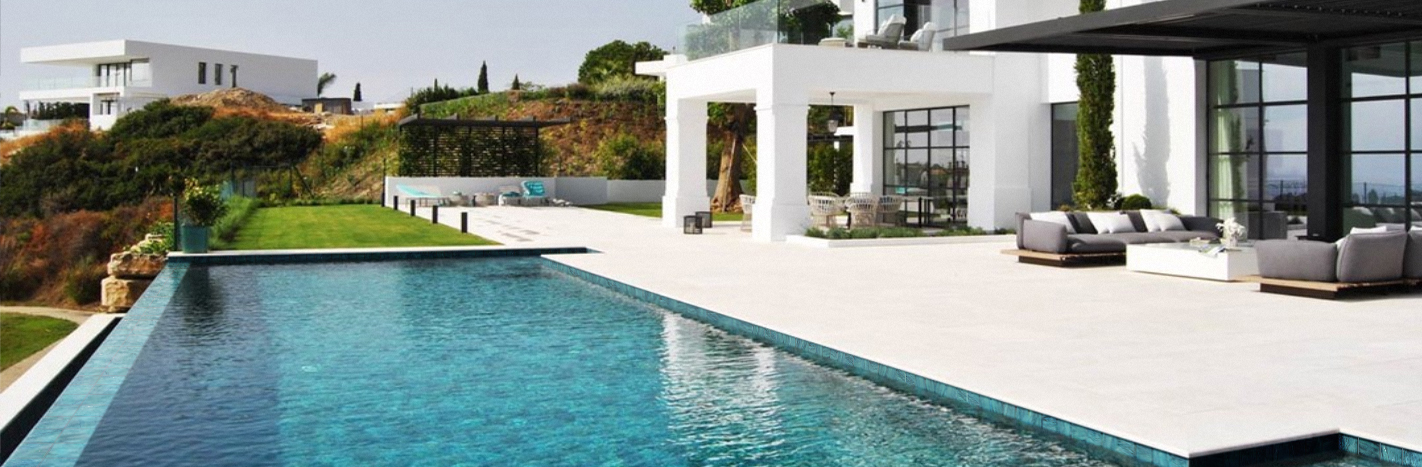
Building a swimming pool is a massive engineering challenge. For contractors and developers, nothing ruins a project—or a profit margin—faster than a callback for cracked or popping tiles. Forensic engineering studies show that over 90% of these tile failures happen because of issues hidden beneath the surface. Usually, the ground shifts under the pool, the waterproofing membrane fails, or the tiles themselves just can’t handle the physical stress.
Fixing these issues means moving away from cheap, generic building materials and looking at the pool as a complete, engineered system. Every phase requires precision, from the initial soil compaction to the strict 28-day concrete curing rule. Sourcing high-performance materials, like ShuangOu Tiles, is a massive step toward meeting lifetime durability standards.
Why Structural Tiles Crack
To fix tile cracking, you have to treat a swimming pool like a dynamic structural ecosystem. Tiles do not crack out of nowhere. They shatter because they are the rigid outer skin of a structure subjected to massive, competing physical forces. If the engineering under the surface fails to neutralize these forces, the mechanical stress transfers right into the tile veneer.
Soil shifting and poor compaction
A standard pool holds tens of thousands of gallons of water. Since every gallon weighs about 8.34 lbs (3.78 kg), a full pool shell weighs several hundred tons.
If the soil geology isn’t surveyed right, or if soil compaction drops below 95% Standard Proctor Density during excavation, this weight causes uneven settling. As one section of the pool drops faster than another, it creates severe shear stress across the shotcrete or gunite shell. Concrete has high compressive strength but lousy tensile strength. These shear forces cause micro-cracks in the pool substrate, which slice the overlying tiles right in half.
Temperature swings
Outdoor pools deal with brutal weather changes. Direct sunlight can heat dark or reflective tiles way past the ambient air temperature, while nights bring a sharp drop.
This constant shifting triggers thermal movement. The big vulnerability here is that concrete, thin-set mortars, and ceramic tiles all expand and shrink at completely different rates. According to data from the Tile Council of North America, when you bond these materials rigidly together without room to move, temperature swings create massive internal compressive stress. The tile veneer is the least elastic part of the system, so it buckles, tents, or cracks under pressure.
Moisture expansion and cheap tiles
Using low-grade, non-porcelain ceramic tiles is a recipe for premature failure. All ceramics have a microscopic structure that can absorb water. When a porous tile is submerged long-term, it undergoes irreversible moisture expansion, swelling over time.
In cold climates, this trapped water becomes destructive. Water expands by about 9% in volume when it freezes. If water gets inside a porous tile body, this 9% volumetric expansion exerts massive internal pressure. This pressure pulverizes the tile from the inside out, causing fracturing, spalling, and surface delamination.
To protect the installation, specifying low-absorption swimming pool tiles, like those from ShuangOu Tiles, is a non-negotiable step during material sourcing.
Steps to prevent cracks during construction
Preventing tile failure requires sticking to real, measurable engineering standards. The work starts long before you set the first tile. Proper soil prep, strict curing timelines, and advanced waterproofing membranes are absolute prerequisites for a finish that lasts.
Soil testing and reinforcement
Every permanent pool starts with geotechnical engineering. Before digging, a soil investigation must look for expansive soils that swell when wet and shrink when dry.
To fight these sub-base movements, the steel reinforcement cage must be built to handle severe bending and shear stress. Standard construction requires a minimum setup of No. 3 or No. 4 rebar spaced in a tight grid. Contractors need to use concrete dobies to suspend the steel grid perfectly in the center of the concrete shell, not resting on the dirt. This ensures that when shotcrete or gunite is sprayed, the embedded steel provides maximum tensile resistance against the hydrostatic weight of the water.
The 28-day curing rule
Rushing the schedule is a primary cause of catastrophic pool tile failure. When you place pneumatically applied concrete, it goes through a chemical process called hydration, shrinking naturally as excess water evaporates.
Per the American Concrete Institute 308 standard, a pool shell must wet-cure for at least 28 days before anyone applies waterproofing, leveling coats, or tile. During these 28 days, the concrete hits about 98% of its ultimate compressive strength, and most of the structural drying shrinkage happens. If you rush into tiling before this 28-day mark, the concrete will keep shrinking under the rigid tile layer. This differential movement creates immense shear stress, snapping the tile bond and causing widespread cracking or tenting.
Multi-layer waterproofing
Once the 28-day curing period is done and the substrate is stable, you need a multi-layer waterproofing and crack-isolation system. Tiling directly over bare concrete is incredibly risky because micro-cracks will easily telegraph from the concrete straight up into the tile.
Contractors should use an advanced, polymer-modified, flexible cementitious waterproofing slurry or a liquid-applied elastomeric membrane. This layer does two things:
- It stops pool water and harsh sanitation chemicals from seeping into the concrete and rusting the internal steel rebar.
- It acts as an elastic buffer that can bridge minor substrate cracks up to 1/8 inch.
If the concrete shell shifts slightly due to weather, the elastic membrane absorbs the energy. This lets the concrete move independently underneath without transferring destructive stress to the ShuangOu porcelain pool tile surface finish.
Stress Relief: The Science of Pool Expansion Joints
No matter how strong a concrete pool shell is built, it cannot completely resist the laws of thermodynamics. Because a swimming pool structure constantly expands when warm and contracts when cold, it must be engineered with the ability to move safely. In high-caliber swimming pool construction, failure to integrate dedicated stress-relief pathways is the primary reason large expanses of tile experience sudden, catastrophic buckling or explosive cracking.
Placement of Movement Joints
To prevent expanding tiles from colliding and crushing one another, the installation must be divided into independent, flexible quadrants using strategically placed movement joints.
According to the Tile Council of North America Handbook, Method EJ171, movement joints are non-negotiable for all exterior tile installations subjected to moisture and temperature extremes. For submerged applications and outdoor swimming pools, the standard dictates that movement joints must be installed every 8 to 12 feet in both directions, forming a continuous grid across the floor and walls.
Furthermore, expansion joints must be placed wherever the tile field meets a restraining surface—such as perimeter pool coping, stairs, light niches, or where the pool floor transitions up into a vertical wall. These joints must cut completely through the tile, thin-set mortar bed, and leveling coat, down to the waterproofing membrane, ensuring that different structural zones can flex independently.
Sealant Selection: Epoxies vs Cementitious Grout
Once expansion joints are properly laid out, filling them correctly determines whether they will succeed or fail. A classic engineering error is using standard cementitious grout across the entire pool surface. Traditional cement-based grouts are rigid, highly porous, and easily degraded by pool chemicals and fluctuating water chemistry. When the pool structure expands, rigid cement grout cannot compress; instead, it transfers the structural stress sideways, causing the tiles to pop or crack.
To provide actual elastic buffering, all designated movement joints must be filled with a highly flexible, pool-grade elastomeric sealant—such as a specialized high-performance polyurethane or 100% silicone sealant meeting ASTM C920 standards.
For the standard tile joints between the movement fields, switching from cement to Epoxy Grout is highly recommended, especially along the highly vulnerable pool waterline. Epoxy grouts provide virtually zero water absorption, exceptional structural bond strength, and incredible resistance to pool chemicals. This ensures that the overall tile matrix remains entirely secure, while the dedicated elastomeric expansion joints safely absorb all structural and thermal shifting, keeping the premium surfaces of your ShuangOu Tiles pristine and intact for decades.
Why Low-Absorption Tiles are Non-Negotiable
Even if your structural foundation is perfect and your expansion joints are flawlessly executed, your swimming pool construction project can still fail if you specify the wrong surface materials. Submerged architectural environments require materials manufactured specifically to withstand continuous immersion, frost cycles, and aggressive chemical exposure.
The Critical Metric: Water Absorption Rate < 0.5%
In commercial and high-end residential aquatic engineering, the primary metric governing tile survival is the water absorption rate. Standard ceramics act like dense sponges, drawing in water, salt, and pool chemicals over time.
| Tile Classification | Water Absorption Rate Standard | Performance Outcome in Pool Construction |
|---|---|---|
| Standard Ceramic Tiles | > 3.0% – 10.0% | High risk of moisture expansion, glaze cracking, and severe freeze-thaw spalling. |
| Standard Porcelain Tiles | < 0.5% (ISO 13006 / EN 14411) | Acceptable for atmospheric use; standard baseline for submerged environments. |
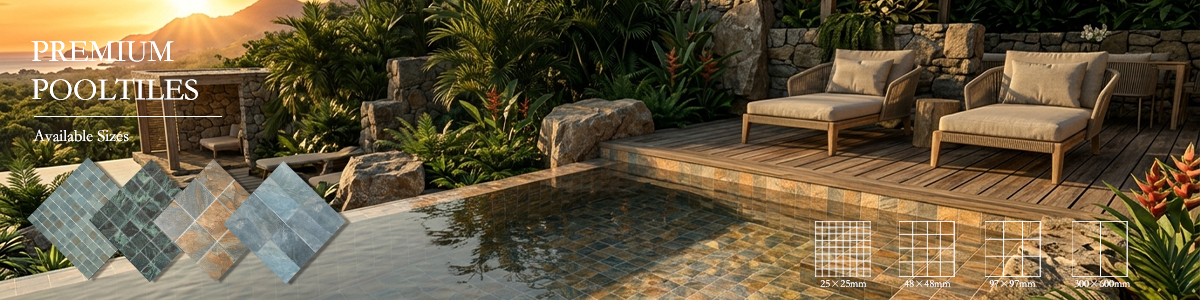
| ShuangOu Premium Pool Mosaics | 0.1% – 0.5% | Maximized density; completely blocks internal moisture expansion and guarantees frost resistance. |
By rendering the tile body virtually non-porous, water molecules are physically blocked from penetrating the internal body of the tile. In cold climates, where absorbed water would otherwise expand by 9% upon freezing and shatter the ceramic matrix, ShuangOu’s frost-resistant engineering guarantees absolute dimensional stability.
Edge and Corner Fittings to Eliminate Stress Concentration
Another major structural vulnerability in swimming pool construction occurs at the geometric transitions—where walls meet floors, or where the pool basin meets the surface deck. Traditional installation methods often rely on field-cutting flat tiles to form sharp, 90-degree angles.
From a structural physics perspective, sharp 90-degree corners create severe stress concentration points. As the pool shell expands and shifts, mechanical energy travels through the substrate and gathers directly at these rigid angles. Because the stress has no smooth pathway to dissipate, the compressed corner tiles inevitably pinch against one another, resulting in sudden fractures, chipping, and sharp, hazardous edges.
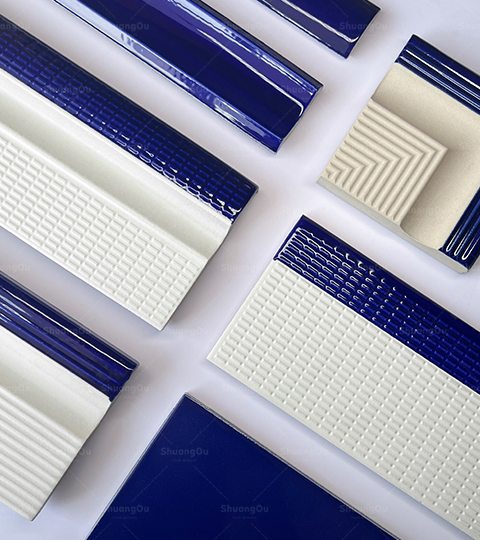
To solve this engineering vulnerability, ShuangOu Tiles provides a comprehensive, fully integrated system of specialized trim and accessory tiles. Instead of relying on risky, field-cut mitered edges, builders can utilize ShuangOu’s purpose-built Internal Corners and External Corners. These accessories feature precisely engineered, radiused profiles that smoothly transition structural planes.
By replacing sharp angles with sweeping curves, structural compression forces are distributed evenly across the surface rather than focusing on a single point, effectively neutralizing stress-induced cracking. Furthermore, this system perfectly integrates with ShuangOu’s professional pool edge Coping and Overflow Grating Tiles, blending world-class structural safety with flawless, hydrodynamic drainage design.
Post-Construction Maintenance: Preserving Tile Integrity
The completion of swimming pool construction marks the beginning of the pool’s operational lifecycle. While structural engineering and elite material selection form the foundation of a crack-free pool, long-term structural integrity requires proactive maintenance. Once the pool is handed over to the client, environmental factors and water chemistry take over.
To ensure that the high-performance tile installation remains pristine, specific post-construction protocols must be strictly followed.
Water Chemistry Balance (pH & Calcium Hardness)
A swimming pool is a massive chemical environment, and imbalanced water chemistry is a silent killer of tile installations. Many builders falsely assume that water chemistry only affects water clarity and swimmer comfort; in reality, it directly impacts the physical bond holding the tile to the substrate.
According to the Association of Pool & Spa Professionalsand ANSI standards, pool water must be maintained within precise parameters:
- pH Level: Must be kept strictly between 7.2 and 7.8.
- Calcium Hardness: Must be maintained between 200 and 400 ppm.
When the pH drops below 7.2, the pool water becomes corrosive and aggressive. In an attempt to naturally balance itself, the acidic water leaches calcium from any cementitious component it contacts, including standard thin-set mortars and grouts behind the tile. Over time, this chemical leaching erodes the bonding matrix, creating hollow voids (delamination) beneath the surface. When hydrostatic pressure or thermal shifts occur, these hollow, unbacked tiles easily crack or pop off.
By maintaining a proper Langelier Saturation Index close to 0.0, pool operators protect both the chemical balance and the structural adhesive holding their ShuangOu Tiles securely in place.
Anti-freeze steps for winterizing
For pools in freezing winter climates, seasonal closing procedures—or winterization—are critical to stop thermal and mechanical tile fractures.
When water freezes, it expands by 9%. If a pool stays full during freezing weather, sheet ice forms across the surface. This expanding ice sheet puts immense lateral pressure right against the waterline tile band, crushing porcelain or glass mosaics and shearing them away from the concrete shell.
To eliminate this force, winterizing protocols dictate that the pool water level must drop at least 4 to 6 inches below the lowest tile line or skimmer mouth before the first hard freeze. This ensures the expanding ice sheet only pushes against bare concrete or the winter pool cover, rather than crushing the waterline tile matrix.
Deploying ice compensation pillows in the center of the pool also helps absorb lateral pressure. Combining these steps with the frost-resistant, low-absorption properties of ShuangOu’s premium porcelain mosaics ensures commercial and residential developers can get through harsh winters without structural cracks.
Conclusion
In commercial and high-end residential building, the success of a pool project is measured by how it performs a decade later, not how it looks on opening day. Cutting corners early on—like rushing concrete cure times, skipping expansion joints, or choosing low-grade, porous tiles—might save money on a spreadsheet, but it is a massive gamble with structural engineering. The financial cost of fixing cracked pool tiles after the fact is staggering. Remediation means draining tens of thousands of gallons of water, setting up climate shelters, jackhammering out failed substrates, re-applying waterproofing membranes, and rebuilding the tile matrix from scratch. National pool restoration averages show that repairing a leaking, delaminated pool surface can easily cost three to five times more per square foot than doing the installation right the first time.
By combining high-performance, low-absorption porcelain surfaces with stress-distributing radial trim systems from ShuangOu Tiles, architects and builders create a preventative blueprint. Choosing specialized materials made for permanent immersion guarantees dimensional stability, frost resistance, and long-term structural cohesion. In modern pool building, prioritizing these engineering fundamentals is the only definitive way to eliminate structural callbacks, protect professional margins, and deliver an aquatic masterpiece built to last for generations.