

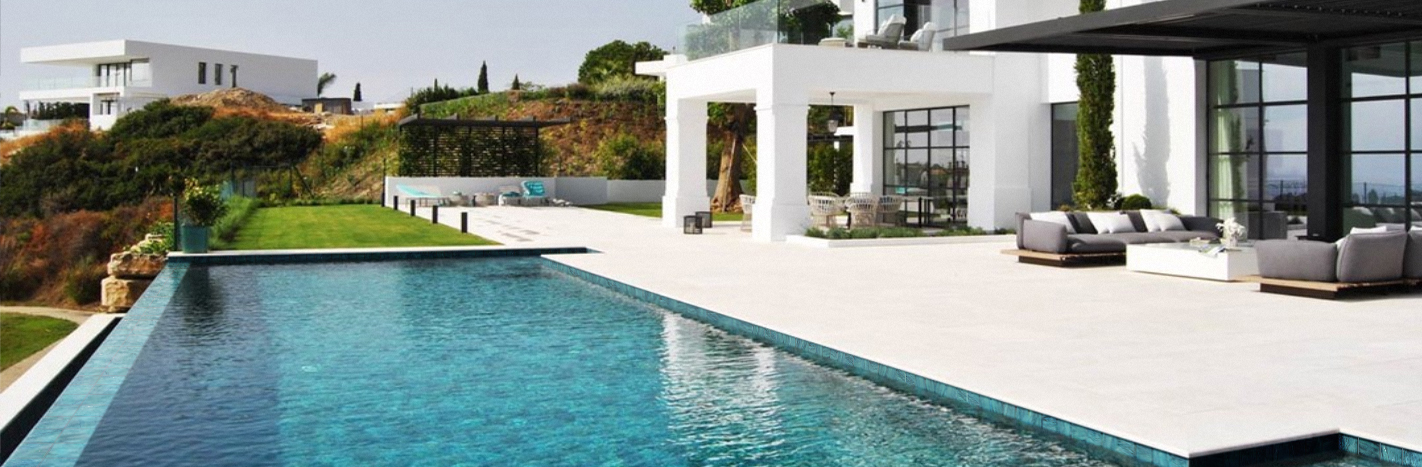
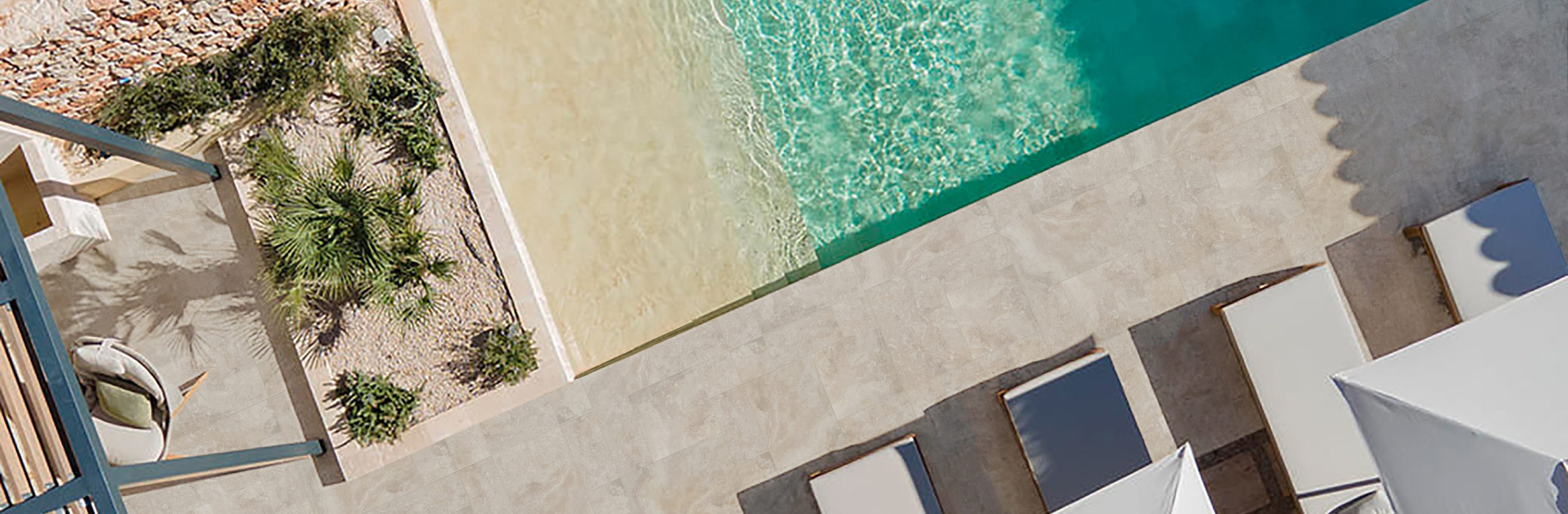
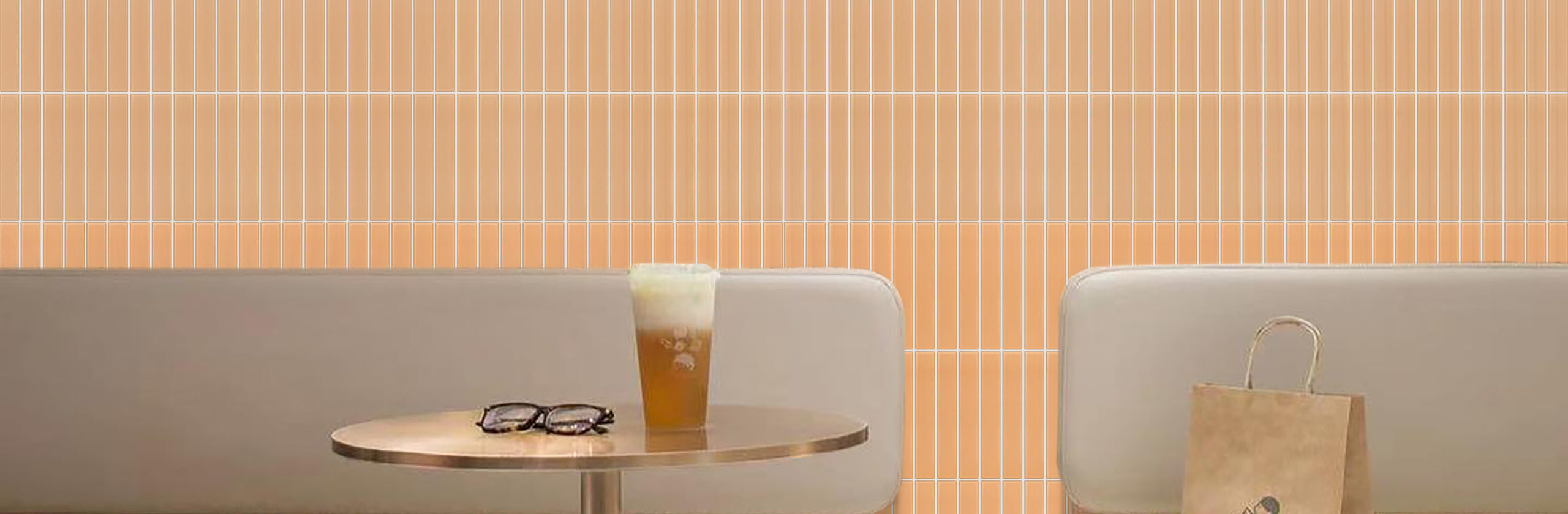
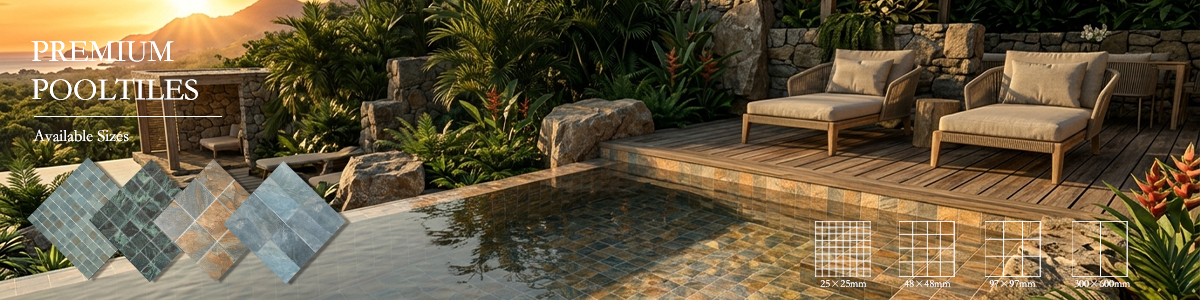
A plain pool does its job. A pool with deco pool tile gets remembered. Decorative tile is the part of a pool that carries the pattern. The waterline band, the sun shelf, the wall behind the spa, that is what a guest sees first when they look at the water.
The catch is that “decorative” and “durable” are not the same brief. A pattern that looks great in a showroom can fade, stain, or pop off the wall within two seasons if the substrate and material are wrong. Pattern is the easy part to get right. Lifespan is the part most buyers underestimate, and it comes down to material and installation more than design. This guide walks through the shapes buyers use, where they belong in a pool, and the specs that keep a deco pattern looking intentional instead of tired.
What a deco pool tile is
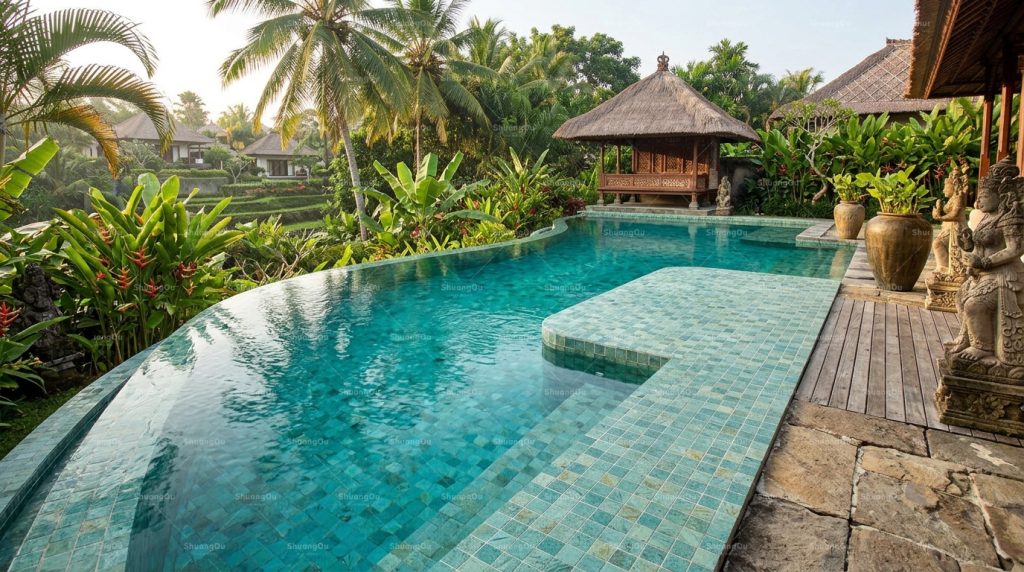
In the pool-tile world, “deco” is a category of decorative porcelain mosaic. Small shaped pieces mounted on mesh or paper sheets, used to build patterns inside and around the pool. Unlike the large-format field tile that covers most of the basin, deco tile is the accent: a geometric border, a dotted insert, a scale-shaped feature panel.
Two things make a deco tile worth specifying:
- It is porcelain, not ceramic. Pool deco tile is vitrified porcelain with water absorption at or below 0.5% (ISO 13006 / EN 14411 Group BIa). That low absorption is what stops the tile from soaking up pool chemicals and freeze-thaw water, the usual cause of spalling and edge cracking in cheaper decorative tile.
- It is sized for pattern, not coverage. Deco pieces run small, 25 mm, 48 mm, 97 mm squares and matching shapes, so installers can lay curves, borders, and repeating motifs that a 600×1200 mm field tile cannot.
ShuangOu makes deco tile as part of the same Foshan porcelain system used across its pool and mosaic ranges. That matters for colour matching: the deco band and the field tile come from the same glaze and body chemistry, so they age the same way.
Deco pieces ship either mesh-backed (installed face-out, the mesh stays buried in the adhesive) or paper-faced (installed face-down, the paper soaked off after the adhesive sets). Mesh backing is the common choice for pools because it lets the installer handle a whole sheet at once and keeps the pattern aligned on curved surfaces. Confirm the mounting method before you order, because it changes how the tile is laid and who can lay it.
Water absorption: the number that decides lifespan
The one spec that predicts whether a deco band survives is water absorption, measured as a percentage of the tile’s weight. Put numbers on it:
| Material | Typical water absorption | What happens in a pool |
|---|---|---|
| Standard ceramic (Group BII/BIII) | 3 to 10%+ | Soaks up chlorinated water; freezes and spalls in cold climates; glaze cracks at the edges |
| Standard porcelain (Group BIa) | ≤0.5% | Stable through chemical and freeze-thaw cycles |
| ShuangOu porcelain deco | 0.1 to 0.5% | Same body as the field tile; ages consistently with it |
A high-absorption decorative tile looks identical to porcelain on day one. The difference shows up in year two: the ceramic piece has taken on water, the glaze edge has micro-cracked, and the pattern looks tired. Specifying ≤0.5% porcelain up front is the cheapest insurance a pool owner can buy.
Frost is the other half of the same story. In any market with freeze-thaw cycles, much of the US interior, parts of Europe, northern China, a non-vitreous deco tile at the waterline will fail. Porcelain at ≤0.5% does not hold enough water to crack from freezing, which is why the porcelain standard, not the pattern, earns a deco tile a place in an outdoor pool.
The shapes buyers use
ShuangOu’s deco collections are organised by shape, and the shape decides where the tile works. The six in active production are:
- Strip: narrow rectangular pieces, the workhorse for waterline borders and linear accents. See the Strip deco tiles for current patterns.
- Square: the cleanest grid option, used for full feature walls and checkerboard inserts.
- Octagon: a classic mosaic look that reads as “period” or “Mediterranean” depending on the colour.
- Penny: round dots on sheet, popular for spa floors and soft, tactile feature panels.
- Fish Scale: overlapping fan shapes, a strong design statement for villa and resort pools.
- Hex: hexagonal mosaic, the modern, slightly architectural choice for contemporary builds.
Pick the shape to follow the pool’s geometry, not just the mood board. A tight curved spa wall suits small squares or penny rounds that bend with the substrate; a long lap pool reads better with strip borders that run the length of the waterline. Shape the choice to the structure and the deco looks designed instead of stuck on.
Installation: where deco tile fails
Most deco-tile problems are not tile problems. They are installation problems. Three habits decide whether a pattern lasts:
- Movement joints. Pool structures move with temperature and ground settlement. Without joints, that movement lands on the grout line at the waterline, which is exactly where deco tile sits. TCNA EJ171 guidance puts movement joints every 8 to 12 ft (2.4 to 3.7 m) and at every change of plane. Skipping them is the most common cause of a cracked waterline band.
- The right grout. Deco tile means a lot of grout line per square metre. Epoxy or urethane grout (ASTM C920 class) resists the chlorine and constant wet-dry cycling that destroys standard cement grout, which stains and crumbles at the waterline.
- Substrate and cure. Tile laid over a green (uncured) pool shell moves as the concrete shrinks. Let the concrete reach its 28-day cure (ACI 308 guidance) before tiling to remove a major source of later stress.
None of this is exotic, but it is the difference between a deco band that looks installed and one that looks built. A manufacturer can supply the right porcelain, but the installer still has to respect the joints. Under the tile, a continuous waterproofing membrane (per TCNA and ANSI references for pool assemblies) stops a cracked grout line from becoming a leaked shell.
Matching deco patterns to the project
Different buyers reach for deco tile for different reasons, and the pattern should answer the brief:
- Villa and private pools: homeowners usually want one signature moment, a fish-scale feature wall, or a hex band at the waterline. Keep the rest of the basin quiet so the deco carries the personality. The risk is overdoing it. Two competing patterns in one small basin reads as busy, not bespoke.
- Hotels and resorts: chain specifications (Four Seasons, Ritz-Carlton, Waldorf Astoria have all taken ShuangOu mosaic) want repeatable, brand-consistent patterns across many rooms and phases. That is where a fixed collection like Wild Africa helps: the Wild Africa decorative mosaic tiles put stone-like graphics on individual pieces, so the pattern survives being split across dozens of installations. The ordering discipline matters as much as the design. A consistent deco language only protects the brand if every phase draws from the same glaze run.
- Commercial and restaurant spaces: deco tile on the wall behind a bar or in a lobby water feature is about ambience and wipe-down maintenance, not swim contact. Porcelain’s stain resistance does the work, and the priority shifts from safety to cleanability and colour stability under artificial light.
There is also a clear direction in what buyers ask for now. ShuangOu’s stated 2026 design turn moves away from ostentatious luxury toward privacy, authenticity, and natural environments. The patterns come from a nature inspiration rather than loud colour. That brief favours deco shapes that read as material (stone, scale, leaf) over deco that reads as decoration, and it is why collections like Wild Africa, built from stone-like graphics, fit the moment better than a saturated primary-colour band.
Where deco tile meets the waterline and coping
Deco belongs at the transition zones, the waterline, the raised beam, the spa lip, and those edges are where pools fail if the trim is wrong. A decorative band that butts straight into a square field tile leaves a hard 90° corner that concentrates stress and pools water.
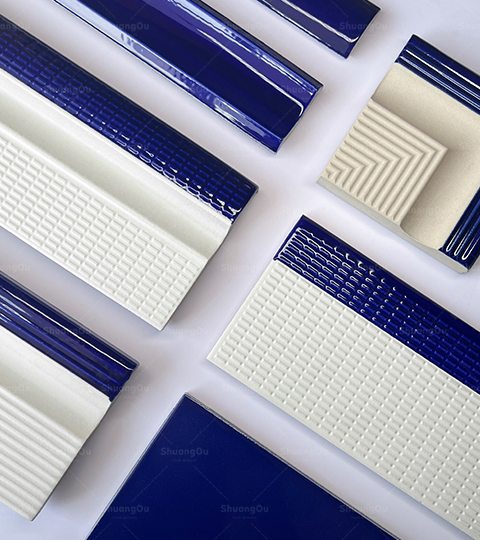
The clean fix is a proper trim system. ShuangOu’s Corner & Edge profiles handle the inside and outside radius turns so the deco band folds around the pool’s corners without a grout line doing structural work. Specifying the profile at the same time as the deco tile, rather than after the fact, is the single most common way to avoid a waterline that cracks within a year.
One practical note on slip: deco tile sits mostly on vertical or near-vertical surfaces (waterline, walls, features), not the walking deck, so its job is pattern and colour fastness rather than walkway grip. The slip-rated surface belongs on the decking and coping around the pool, where bare feet land. Keep those two roles separate and the pool is both safer and easier to maintain.
Material and compliance specs that matter
When you compare deco pool tile across suppliers, these are the numbers that separate a tile that lasts from one that doesn’t:
| Spec | Why it matters | What to look for |
|---|---|---|
| Water absorption | Drives frost and chemical resistance | ≤0.5% (porcelain, ISO 13006 BIa) |
| Glaze colour fastness | Stops fading under UV and chlorine | Stable ceramic glaze, tested batch |
| Chemical resistance | Pools are a corrosive environment | Resists chlorine and pH-range exposure |
| Dimensional consistency | Controls grout line width and flatness | Tight per-line size tolerance |
| Body/shade match | Deco and field tile must age alike | Same glaze system across the range |
Beyond the numbers, ask for the test backing. Reputable pool porcelain is verified to ISO 13006 / EN 14411 for absorption and to chemical-resistance standards for the glaze. ShuangOu’s pool ranges carry FINA, ISO 9001, 3C, ISO 14001 and TUV certification, and the deco tile shares the same porcelain body. So a deco insert in a competition basin sits inside a compliant field specification rather than outside it. For a private villa that level of certification is overkill, but the porcelain standard underneath it is the reason a deco band stays put.
Two more specs are worth noting for buyers in regulated or health-conscious markets. ShuangOu pool porcelain is produced to GB/T 4100-2006 and carries a Class A radioactivity rating, the unrestricted-use grade, so it is cleared for residential and public projects without limitation. Its glaze also resists the common pool acids used in pH correction better than a standard ceramic, which matters wherever the water chemistry is actively managed rather than left to drift.
Custom patterns and project planning
Off-the-shelf shapes cover most jobs, but a resort or branded development often wants a pattern that is theirs alone. ShuangOu runs OEM/ODM with in-house design, the same team that develops the standard collections, so a custom deco motif can be produced as long as the material stays porcelain and the size stays in the manufacturable range. The Ocean Glacier pool tiles show the other end of the same system: a crystal-blue field mosaic (48 mm and 25 mm sheets) that a deco band is meant to sit against.
For a bespoke mural or logo, the design team works from the project’s artwork and the pool’s actual dimensions, because a pattern that looks right on a screen rarely maps cleanly onto a curved basin. ShuangOu’s designers research international tile fairs and study regional aesthetics, so a custom deco can reference a local material, travertine, basalt, hand-painted ceramic, without the maintenance cost of the real thing. Lead time is the trade-off: a custom collection needs artwork sign-off and a production slot, so it belongs at the front of the schedule, not the back.
On cost: deco covers a small area, so the tile itself is usually a modest share of a pool’s material budget. The larger variable is installer skill, because mosaic laying is slower and less forgiving than field tile. Budgeting for an experienced mosaic installer protects the pattern more than spending up on the tile does.
Two planning points that save projects later:
- Order deco and field tile together. Because colour matching depends on the same production run, splitting the purchase across suppliers or months risks a visible shade difference at the seam.
- Confirm stock before committing the schedule. ShuangOu keeps a 35,000 sqm stock warehouse and operates with no minimum order quantity, which matters for phased hotel rollouts where one wing gets tiled six months after another.
Buyer checklist before you specify
- Shape follows structure: curved spas use small squares or penny rounds; long lap pools use strip borders.
- Porcelain, not ceramic: verify ≤0.5% water absorption in writing.
- Movement joints specified: TCNA EJ171 spacing at every change of plane.
- Epoxy / urethane grout: not cement grout at the waterline.
- Trim specified up front: corner and edge profiles ordered with the deco, not after.
- Deck slip handled separately: grip belongs on coping/decking, not the decorative band.
- Deco and field from one source: same glaze system, ordered together.
- Custom needs lead time: start OEM/ODM discussion before the tile schedule locks.
Work with a manufacturer, not a catalogue
A deco pool tile only pays off when the pattern, the trim, and the field tile are planned as one system. ShuangOu is a Foshan ceramic mosaic and pool tile manufacturer with 15 years of export experience, three factories over 300,000 sqm with 10 production lines, and certifications covering FINA, ISO 9001, 3C, ISO 14001 and TUV. It supplies mosaic to hotel groups including Four Seasons, Ritz-Carlton and Waldorf Astoria across 100+ countries.
If you are specifying deco tile for a villa, resort, or commercial water feature, send the project details: pool shape, tile size, the look you are after, and where the deco will sit. For custom work, share the artwork or reference image early. The longer the lead time, the more choices stay open. We will review the pattern against the structure, suggest the right shape and trim, and outline export packaging and logistics so the tile arrives matched and on schedule.


