

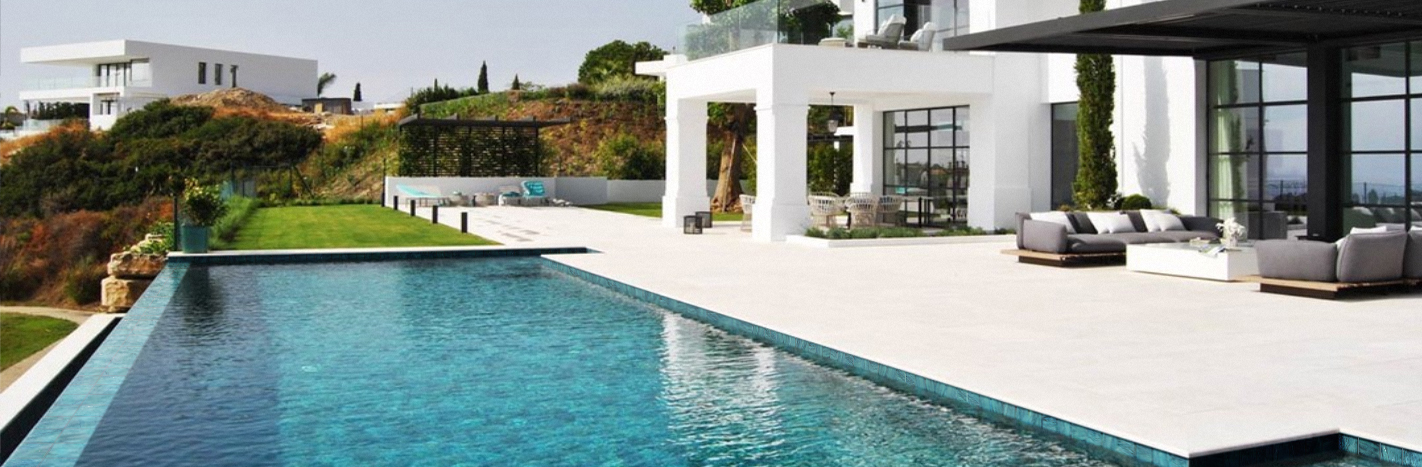
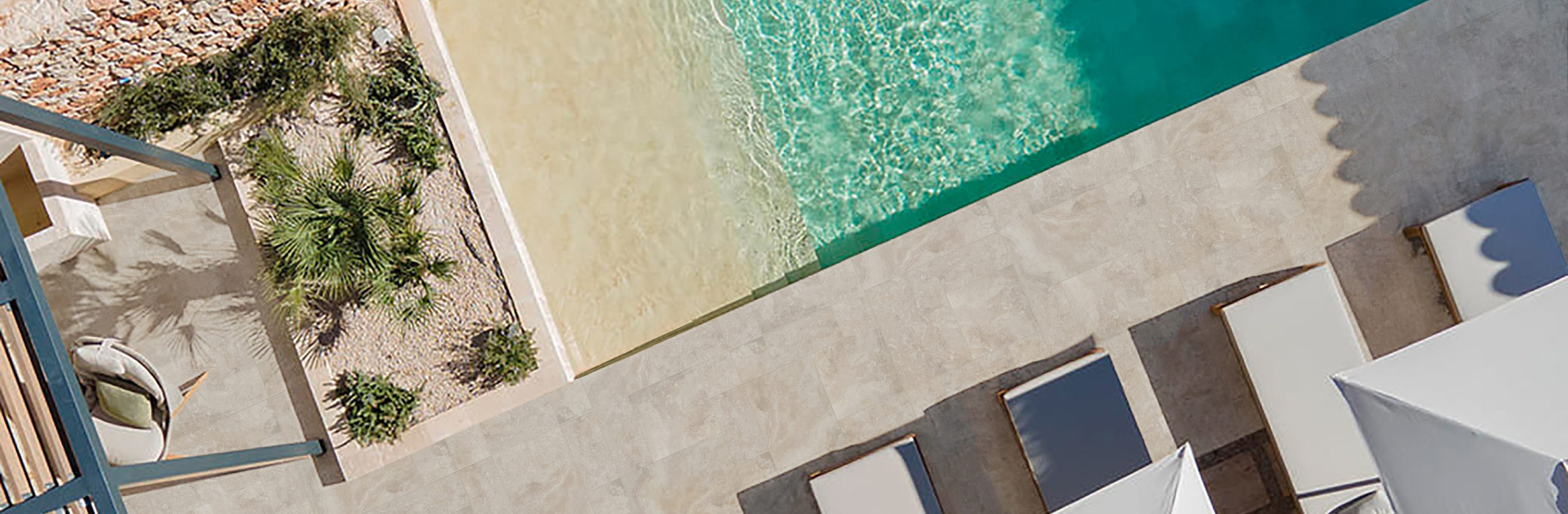
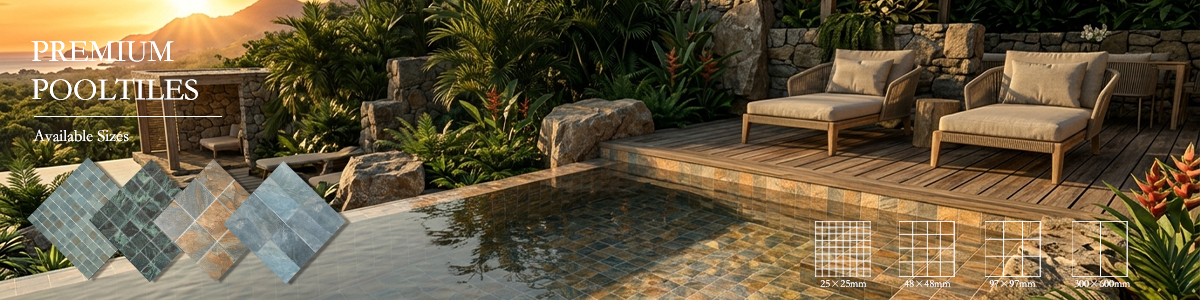
A pool deck is the surface people actually walk on barefoot, with wet feet, carrying drinks, and chasing children. The tile you choose for that deck decides whether the space feels like a safe resort or a liability. For importers, builders, architects, and homeowners specifying a pool deck tile, the decision is rarely about colour alone — it is about slip safety, water absorption, freeze-thaw behaviour, and how the deck reads against the pool tile itself.
This guide walks through material choices, the slip-rating codes that actually matter, format and installation logic, and how to coordinate decking with the pool interior. Where relevant, we reference real product lines from ShuangOu, a Foshan-based ceramic mosaic and porcelain tile manufacturer with 15 years of export experience, three factories (300,000+ sqm), ten production lines, and a 35,000 sqm stock warehouse supplying 100+ countries.
What counts as a pool deck tile
“Pool deck tile” covers every tiled surface around the water: the coping transition, the sun shelf, the wet border, the walkways, and the lounging terrace. It is a different job from the pool interior. Submerged tile must survive continuous hydrostatic pressure and chemical attack; deck tile must survive foot traffic, standing water, thermal swing, and — above all — slipping feet.
That distinction drives every spec below. A tile that looks right on a showroom wall can fail on a sun-baked, chlorine-splashed deck in Dubai or a frost-prone patio in Harbin.
Material comparison: porcelain, stone, ceramic, concrete
| Material | Water absorption | Barefoot slip risk | Frost resistance | Maintenance |
|---|---|---|---|---|
| Porcelain (vitrified) | ≤ 0.5% (ISO 13006 / EN 14411, Group B Ia) | Low with textured/R-rated face | Excellent (low absorption) | Low |
| Natural stone (travertine, slate) | 1–5%+ (porous) | Variable, needs sealing | Poor unless dense & sealed | High (re-seal) |
| Glazed ceramic | 3–10%+ (non-porcelain) | Moderate | Weak, can spall | Medium |
| Concrete / paver | High | High when polished/wet | Cracks with freeze-thaw | High |
Porcelain wins on the metrics that matter for a deck: it is dense, low-absorption, colour-stable, and can be produced with a structured (anti-slip) surface. Natural stone reads beautifully but is porous, requires ongoing sealing, and genuine stone is unsafe as a pool interior because it absorbs water and deteriorates. For the deck, a porcelain tile that looks like stone gives the aesthetic without the maintenance.
Slip resistance: the codes that matter
This is the single most important spec for a pool deck, and the most misunderstood. Two systems apply:
DIN 51130 (R-rating). An oil-wet ramp test returns a class from R9 (lowest) to R13 (highest slip resistance). For barefoot wet areas — pool surrounds, spa aprons, shower decks — the industry narrows to R11 to R13. R9–R10 are fine for dry interiors but not for a wet deck.
DCOF (Dynamic Coefficient of Friction). Measured under ASTM C1028 / ANSI A137.1, TCNA recommends a minimum DCOF of 0.42 for level interiors expected to be walked on wet. For exterior barefoot decks, aim higher; pair DCOF with the R-rating rather than trusting one number.
ShuangOu’s decking lines are built around these codes rather than vague “non-slip” claims. The pool deck tile range includes an R12-rated wood-grain porcelain — a structured face that grips bare feet yet reads as warm timber — and an R13 marble-look tile for hospitality decks that need a polished-resort appearance without sacrificing grip. Specifying the R-code in the purchase order removes ambiguity between buyer and factory.
Format, expansion joints, and thermal movement
Large-format deck tiles (600×600 mm, 600×1200 mm) are now standard for contemporary pools. Fewer grout lines mean less cleaning and a calmer visual plane, but large tiles move more with temperature, so joints matter more, not less.
Follow TCNA EJ171 movement-joint guidance: place expansion joints every 8–12 ft (2.4–3.7 m) across the field, at every plane change, and around fixed elements (drains, copings, walls). Use a flexible, weather-rated sealant in those joints — not grout. Decks also need a drainage slope (typically ≈2%, or 1/4 inch per foot) away from the water so standing water never becomes a slip hazard.
Coordinating the deck with the pool tile
A deck and a pool interior are one composition. The easiest mistake is selecting them in isolation, then discovering the deck clashes with the waterline. Three rules:
- Repeat one tone. Pull a colour from the pool mosaic into the deck, or vice versa, so the eye reads them as a set.
- Mind the coping and edge. The rounded or square edge where deck meets water is the highest-traffic, highest-risk line on the whole pool. Treat it as a deliberate component, not an afterthought.
- Balance finish. A high-gloss interior mosaic pairs well with a matte, structured deck — the contrast is intentional and safer underfoot.
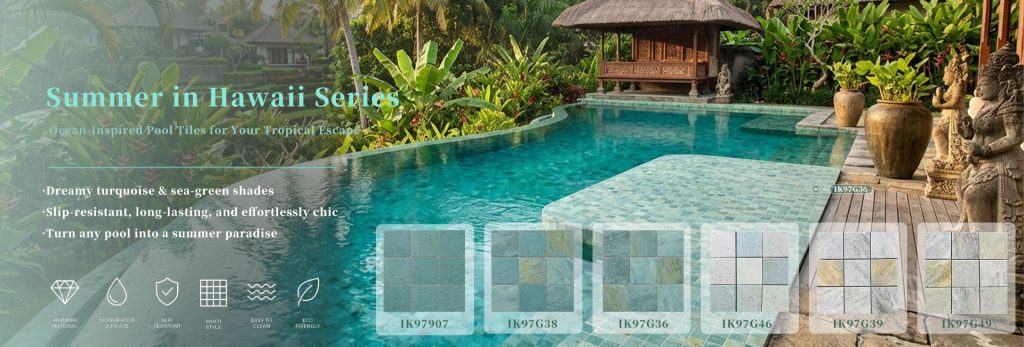
ShuangOu’s R13 marble-look deck tiles sit naturally beside cooler blue pool mosaics for a luxury-resort read, while the wood-grain R12 line suits villa courtyards and naturalistic landscapes. For the waterline itself, Ocean Glacier porcelain pool tiles from the Wave series give a glacial blue that coordinates with either deck direction.
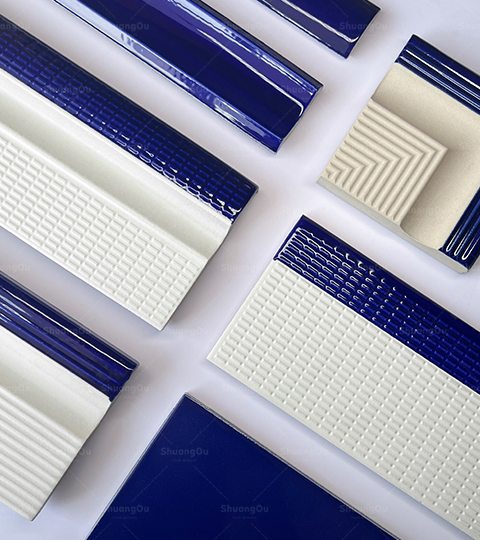
Where the deck meets the coping, Corner & Edge profiles handle the transition with purpose-made bullnose and edge pieces, keeping the junction safe and visually clean rather than field-cut on site.
Substrate, waterproofing, and bond
Deck failure almost always starts below the tile. Minimum spec for a durable pool deck:
- Substrate: reinforced, cured concrete (observe ACI 308 curing — roughly 28 days) with the correct drainage slope.
- Waterproofing: a liquid or sheet membrane rated for continuous wet exposure (ANSI A118.10) beneath the tile, especially over occupied spaces or where leakage is unacceptable.
- Bond: an improved modified thin-set (ANSI A118.4) or, for large formats, a polymer-modified mortar with back-buttering to remove voids.
- Crack isolation: a membrane where slab movement is expected, to stop reflected cracks from reaching the tile.
A common failure mode is bonding large-format porcelain to a damp or green slab with the wrong mortar — the tile stays put, the bond lets go, and you get hollow-sounding, loose deck tiles within a season.
Large-format outdoor floor alternatives
Not every deck needs a 600×600 tile. For broad terraces and commercial promenades, 600×1200 mm large-format outdoor floor tiles give a near-seamless stone-plinth look and fewer joints to maintain. The same porcelain logic applies: low absorption, R-rated structured face, and colour-through bodies that hide edge chipping. Choose the format based on the substrate’s flatness tolerance — larger tiles exaggerate any fall defect, so the screed must be tight.
Procurement for importers, builders, and projects
For B2B buyers, the tile is only half the decision; the supply chain is the other half. Typical pain points are minimum order quantity, lead time, and export documentation. ShuangOu addresses these with a 35,000 sqm stock warehouse and no-MOQ policy, plus OEM/ODM and one-stop foreign trade service (packaging, export paperwork, logistics). Certifications held include FINA, ISO 9001, 3C, ISO 14001, and TUV — relevant when projects require compliance evidence for tender or hotel-group specification.
Real decking options to shortlist
Two lines cover most specifications:
- R12 wood-grain porcelain decking — structured anti-slip face, timber aesthetic, ideal for villa courtyards, rooftop pools, and naturalistic landscapes where wood would rot or splinter.
- R13 marble-look deck tile (600×600 mm) — highest slip class in the range, polished-resort appearance, suited to hotels, clubs, and high-traffic commercial decks.
Both are porcelain (≤0.5% absorption), frost-resistant, and colour-stable under UV — verifiable properties of vitrified porcelain rather than marketing claims.
Maintenance and longevity
A porcelain deck is low-maintenance but not no-maintenance. Routine care:
- Sweep and rinse to remove abrasive grit that can micro-scratch the face.
- Use a neutral pH cleaner; avoid harsh acid that attacks grout and some textured glazes.
- Inspect movement joints annually and re-seal if the bead has hardened or shrunk.
- Keep copings and edge pieces intact — a chipped edge is both a safety and a water-intrusion risk.
Done right, a porcelain deck outlasts the coping it sits beside and avoids the re-sealing cycle that natural stone demands.
FAQs
What slip rating do I need for a pool deck?
Aim for R11–R13 under DIN 51130, and verify DCOF (ANSI A137.1) for wet barefoot use. R9–R10 are for dry interiors.
Is porcelain or natural stone better for a pool deck?
Porcelain, for a deck. It is denser, lower-absorption, frost-proof, and needs no sealing. Stone looks great but is porous, slips when wet, and requires ongoing maintenance.
Can I use the same tile inside the pool and on the deck?
Not usually. The interior needs submersion-rated, chemically resistant tile (often mosaic); the deck needs a structured, slip-rated face. Coordinate them as a set instead of using one product for both.
Do large-format deck tiles crack more easily?
Only if the substrate or joints are wrong. With proper slope, movement joints (TCNA EJ171), and the right mortar, large formats perform well and show fewer grout lines.
What about freeze-thaw climates?
Specify vitrified porcelain (≤0.5% absorption) and a crack-isolation membrane. Low absorption is what lets porcelain survive repeated freezing without spalling.
Conclusion
Before you request a quote, lock these down: deck area and format, required R-rating and DCOF, colour direction (match to pool tile), coping/edge profile, substrate condition, and climate (frost or not). Send those to the factory with your project drawings.
ShuangOu’s technical team can return a matched deck-and-pool specification — including the R12 or R13 decking line, coordinating pool mosaic, and Corner & Edge profiles — and advise on export packaging and lead time from stock. Share your pool shape, deck dimensions, and target aesthetic to get a free technical consultation and a sample plan.


