

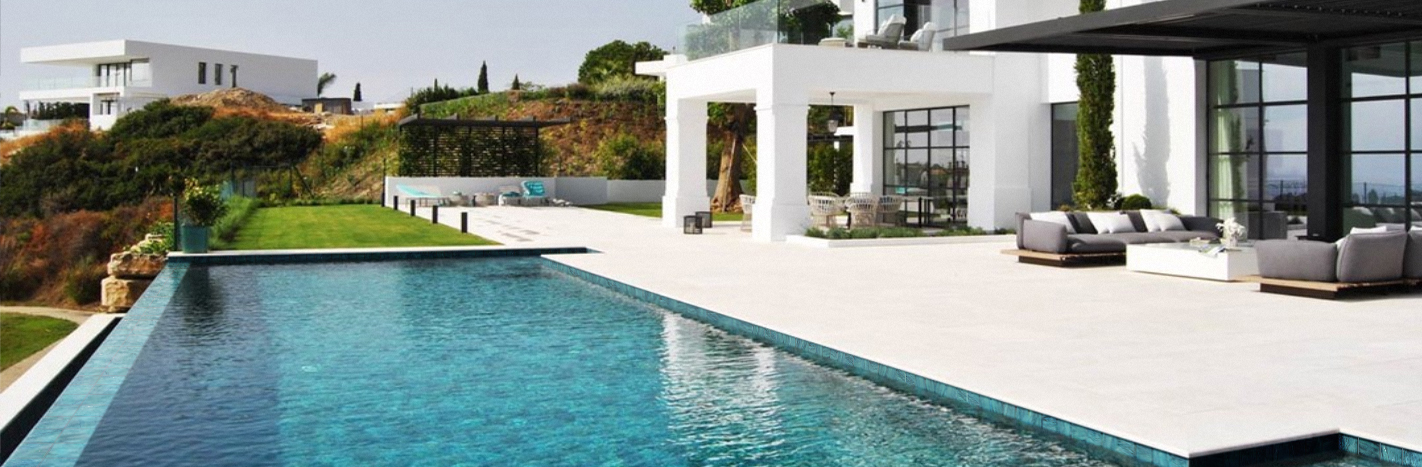
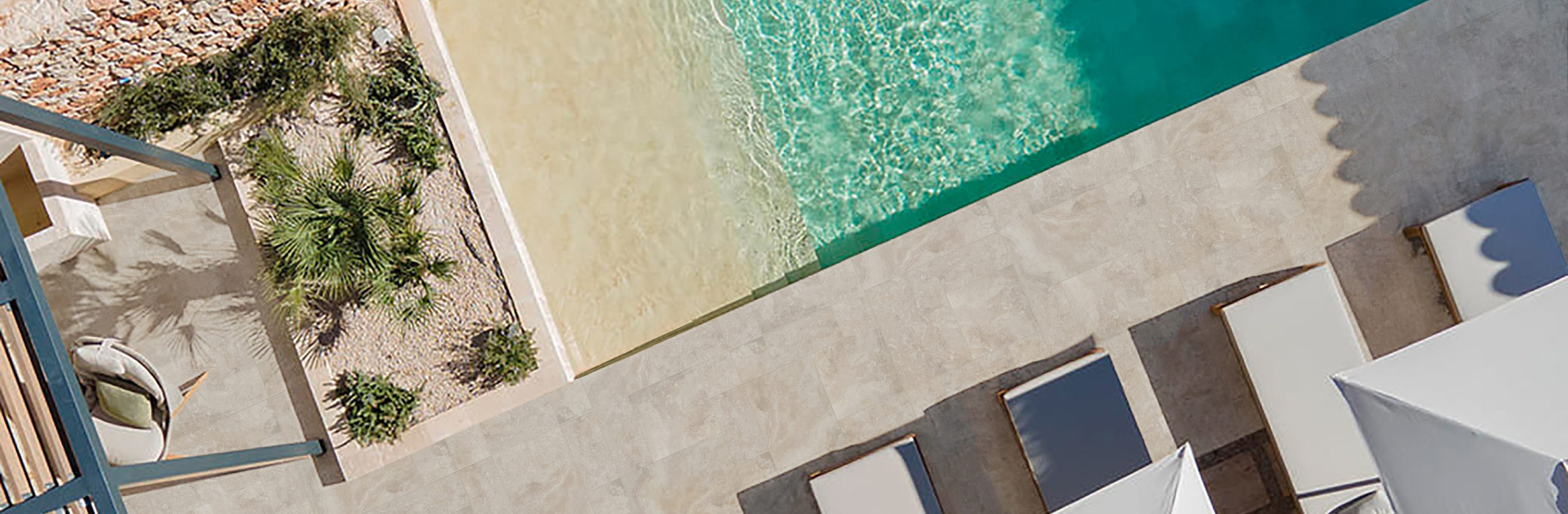
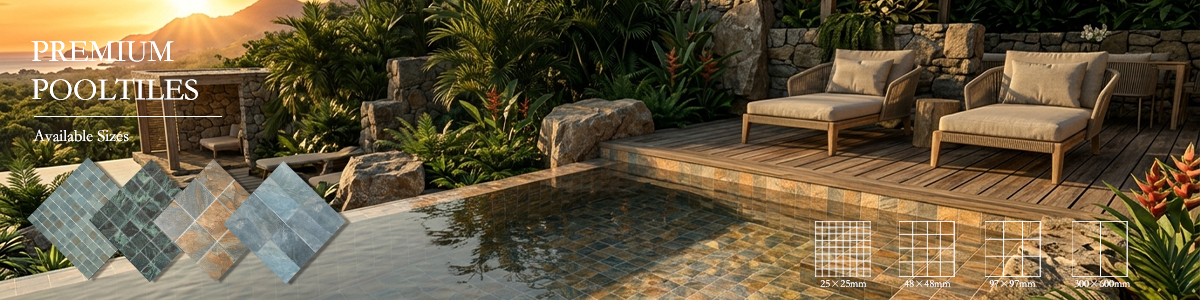
A pool surround is the one tiled surface where people walk barefoot and wet, often with sunscreen on their legs and a child tugging at their hand. Slip safety there is not optional. It is the difference between a deck people admire and a deck that turns into a liability note. So when a buyer asks for a pool surround non slip tile, the answer should start with a number, not a description of how the surface feels.
ShuangOu supplies porcelain pool tiles and decking to projects in more than 100 countries, from private villas to resort pools run by groups like Four Seasons, Ritz-Carlton and Waldorf Astoria. In that catalog, the surround question keeps coming back to the same few points: what the slip rating measures, why porcelain wins over ceramic near water, and how the deck, coping and pool interior should be specified together instead of fighting each other.
What a pool surround non slip tile is
The term covers the tiles laid on the flat deck around the pool, plus the coping that caps the pool wall and the wet edge where water meets the floor. In practice it is any tile rated to stay grippy under bare wet feet. Two things define it:
- The material is low-absorption porcelain, not ordinary ceramic. Porcelain sits at or below 0.5 percent water absorption under ISO 13006 and EN 14411, so it does not soak up pool water, swell, or split in freeze cycles.
- The surface carries a measured slip rating, not just a “rough” feel. Texture helps, but a rated number is what lets an architect sign off and an insurer stay quiet.
Pool surrounds carry different stresses than the pool interior. The interior stays submerged. The surround lives in the splash zone, the sun and the freeze-thaw band. That is why the slip rating, not the colour, should drive the first cut of the shortlist.
How slip rating works, in plain terms
Two systems matter for pool work.
The DIN 51130 R-scale runs from R9 (low resistance) up to R13 (highest). Barefoot wet areas such as pool surrounds and public wet rooms are where R11, R12 and R13 belong. R9 and R10 are fine for dry or lightly damp commercial floors but not for a pool deck where people run.
The ANSI A137.1 standard uses a Dynamic Coefficient of Friction, or DCOF. A level interior floor needs a DCOF of at least 0.42. A submerged-edge barefoot area needs more margin than that number implies, which is why many specifiers lean on the R-rating for the surround even when they quote DCOF for the indoor sections.
The easy mistake is assuming “it looks matte, so it is safe.” A matte tile with a closed body can still read low on the R-scale once algae film or body oil builds up. The rating, tested on the actual product, is the only honest signal.
Porcelain versus the alternatives
Around a pool, the usual alternatives are natural stone, ordinary ceramic, and porcelain. They behave very differently once water is involved.
| Material | Typical water absorption | Behaviour on a wet surround | Notes |
|---|---|---|---|
| Ordinary ceramic tile | 3 to 10 percent | Soaks water, can spall in frost, loses grip as it ages | Cheap up front, costly to maintain |
| Natural stone (unglazed) | Varies, often 1 to 5 percent | Porous, needs constant sealing, albedo changes with wear | High aesthetics, high upkeep |
| Standard porcelain | Below 0.5 percent | Stable, dense, holds its rated grip | The baseline for pool decks |
| ShuangOu porcelain | 0.1 to 0.5 percent | Same density, tested slip grades R12 to R13 on deck lines | Stock held, made on one body chemistry |
The reason ShuangOu cites 0.1 to 0.5 percent rather than just “under 0.5” is consistency. When the deck and the coping come off the same porcelain body, they expand and contract together, which keeps the joints honest through a season of temperature swings.
ShuangOu deck lines built for the surround
Two lines in the ShuangOu decking range are made specifically for the wet perimeter.
The R12 porcelain wood deck tiles from ShuangOu carry an R12 slip grade and a wood-look finish in 150 by 900 mm planks (codes W15901R through W15905R). The wood grain reads warm underfoot without the maintenance of real timber, and R12 is the grade most pool builders accept for residential decks.
The R13 marble-look deck tiles step up to R13, the top of the DIN 51130 scale, in 600 by 600 by 9 mm tiles (LM666, LM665, RF601, RF602, RS605). For public pools, hotel decks and anywhere foot traffic is heavy and barefoot, R13 is the safer call.
Both lines share the same porcelain body as the rest of the ShuangOu pool program, which matters when the deck meets the coping and the coping meets the waterline tile. Colour and expansion stay matched.
Matching the surround to the pool interior
A surround should not be specified in isolation. The deck, coping and interior tile form one visual and one structural system.
For a blue or ice-toned pool, the Ocean Glacier pool tiles from the Wave series give a crystal blue ice mosaic in 48 by 48 mm and 25 by 25 mm chip sizes on mesh sheets. A pale marble-look R13 deck sits cleanly beside that waterline without competing with it. The point is not to match exactly but to keep the same temperature of colour so the eye reads the pool as one object.
ShuangOu designs each pool series from a single nature reference, so the deck and the interior are developed to age the same way. That is a small thing on day one and a large thing in year five.
Coping and edge transition
Where the deck ends and the pool begins, the tile changes plane. That joint is where most trips happen, so it needs its own part.
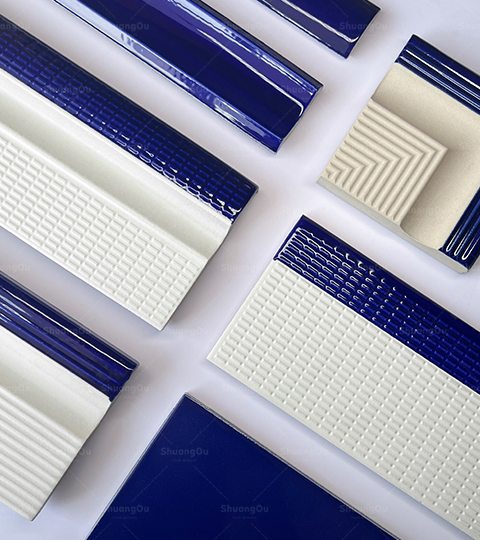
The corner and edge profiles in the ShuangOu range handle the radius and the outside corner so the coping does not end in a sharp square edge. A rounded nosing spreads the load and removes the catch point. Specifying the profile at the same time as the deck, not after, is what keeps the project from a last-minute coping substitution that breaks the slip grade.
Where non-slip surround tile fails
Most surround failures are not about the tile being wrong. They are about the tile being right and the build around it being wrong.
- Wrong rating for the use. An R10 deck in a family pool with a slide will slip. Match the rating to barefoot wet traffic, not to a showroom feel.
- No expansion joints. TCNA EJ171 calls for movement joints roughly every 8 to 12 feet and at every plane change. Skip them and the porcelain, dense as it is, gets forced by thermal movement until the grout cracks and the edge lifts.
- Wrong adhesive and grout. Pool surrounds need a polymer-modified adhesive and an epoxy or urethane grout rated for submersion-adjacent wet areas. ASTM C920 covers the sealant grade; a standard sanded grout in a splash zone stains and weakens.
- Rushed curing. ACI 308 gives the 28-day curing window for the slab and the setting bed. Pour the deck and tile it in a week and the slab keeps moving under the tile.
None of this is exotic. It is the difference between a surround that looks installed and one that looks built.
Specifying for a project
For importers, builders and developers, the surround is usually one line in a much larger bill of materials, and that is where ShuangOu’s production model helps.
The Foshan operation runs three factories over 300,000-plus square metres with 10 production lines and a 35,000 square metre stock warehouse, so standard deck and coping items ship without a minimum order quantity. For a renovation or a staged resort build, that removes the “order 5,000 square metres or wait 12 weeks” problem. OEM and ODM are supported, and the export packaging and documentation are handled as a one-stop service, which matters for distributors landing product in Southeast Asia, the Middle East, Australia or Africa.
The compliance baseline is the same across the range: ISO9001, 3C, ISO14001 and TUV certifications, plus FINA approval on competition lines. For a private villa that level of certification is overkill, but the porcelain standard underneath it is the same reason a deco band or a deck stays put.
Where this tile goes
The non-slip surround comes up in a few repeat situations.
- Private villa pools, where the client wants warm wood-look or stone-look decking that children can run on.
- Resort and hotel pools, where foot traffic is constant and the operator cannot close the deck to regrout. R13 is the default there.
- Commercial and dining spaces beside water, where the floor slopes to a drain and barefoot traffic mixes with service traffic.
- Renovation projects, where the old deck is lifted and a rated porcelain replaces it without rebuilding the substrate if the slab is sound.
In each case the surround is specified with the coping and the interior, not as a separate purchase.
Buyer checklist before you specify
- Confirm the barefoot traffic level, then pick R11, R12 or R13 accordingly.
- Fix the material as porcelain below 0.5 percent water absorption.
- Choose deck, coping and waterline from one supplier program so the body chemistry matches.
- Order the corner and edge profiles with the deck, not after.
- Write the expansion-joint spacing and the grout grade into the spec.
- Check stock and lead time against the build schedule, especially for staged projects.
FAQs
What slip rating do I need for a pool surround?
For barefoot wet areas, R11 is the floor and R13 the ceiling on the DIN 51130 scale. Residential family pools usually land on R12; public, hotel and busy shared decks should use R13.
Can I use the same tile inside the pool and on the deck?
Not usually. The interior is submerged and graded for that; the surround is graded for barefoot wet traffic and sun exposure. Use a rated deck line for the surround and a pool-rated tile for the interior, and match them by colour family.
Do I need expansion joints on a porcelain deck?
Yes. Porcelain is stable, but the slab under it moves with temperature. TCNA EJ171 spacing of about 8 to 12 feet, plus joints at every plane change, protects the grout and the edge.
Does ShuangOu hold stock for surround and coping lines?
Standard deck and coping items are held in the 35,000 square metre warehouse with no minimum order quantity. Custom colours or profiles go through the OEM and ODM route with a longer lead time.
Talk to the factory
If you are specifying a pool surround, send the pool shape, the deck area, the traffic level and the colour direction. ShuangOu can match the deck, coping and waterline from one porcelain program, confirm the slip grade for the use, and advise on joint spacing and export packaging for the destination market.


