
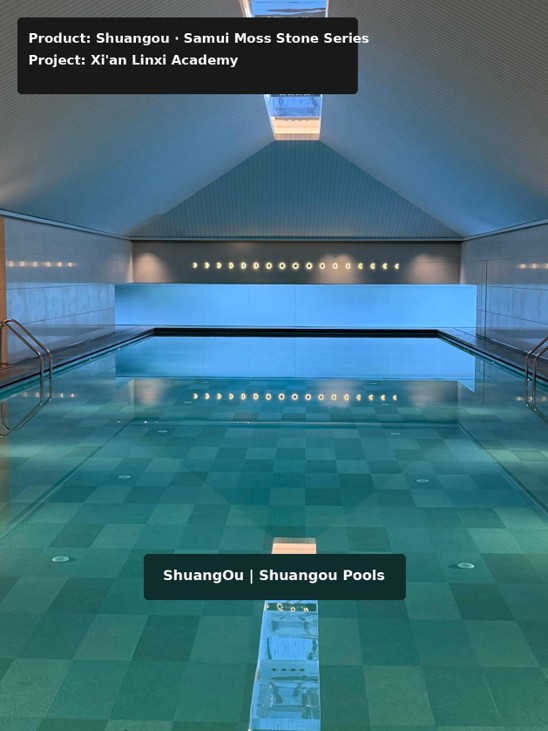
In the Xi’an Linxi Academy indoor pool project, Shuangou Ceramics took part in the crucial stage of turning the design concept into a built material solution. The designer came to Shuangou with the preliminary pool renderings, looking for a pool material that could reproduce the intended atmosphere as closely as possible while also being suitable for real installation. Based on the overall color relationship in the renderings, Shuangou recommended four 300 × 600 mm pool tiles in different tones and used a mixed-color layout to complete the approximately 300 m² indoor pool. When a swimming-pool space is actually built, material selection is often far more complex than it appears in a rendering—especially for an indoor pool. The designer must consider not only “which color to choose,” but also the water color after large-area installation, changes in depth and tone, the overall visual rhythm, and whether the result works with the architecture and lighting.
When a Designer Brings a Rendering, the Real Challenge Is “How to Make It Work in Reality”
The pool color shown in a rendering is usually the designer’s initial vision for the overall atmosphere. In real material selection, however, there is a practical issue: the color of a single tile is not the same as the color it creates after covering a 300 m² pool. A color may look attractive on its own but become too flat over a large area; too many color variations, on the other hand, can look chaotic.
With the combined influence of the water, indoor lighting, natural light, and surrounding architectural materials, what people finally see is not simply “tile color,” but: tile color × water color × light × laying ratio.
For this reason, Shuangou did not simply search for one tile that “looked most similar” to the rendering. Instead, the material combination was worked backward from the visual effect desired for the completed pool. This is one of the biggest differences between pool-material selection and ordinary wall-and-floor tile selection.
Why Mix Four Pool Tiles Instead of Using One Tile Throughout?
Judging from the design, the Xi’an Linxi Academy pool was not intended to be a bright, uniformly blue body of water. The architecture is relatively restrained: large light-colored ceilings, stone columns, warm-toned walls, and natural light create a calm spatial relationship. The pool itself therefore could not be overly dominant. If only one color were used across the entire area, the 300 m² water surface could easily feel too flat and lack variation.
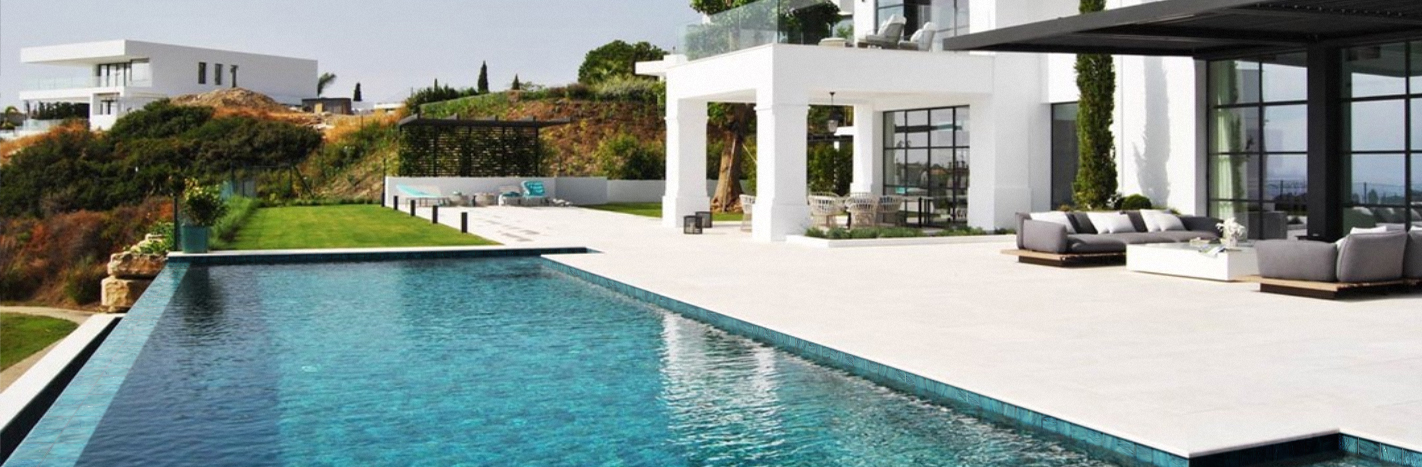
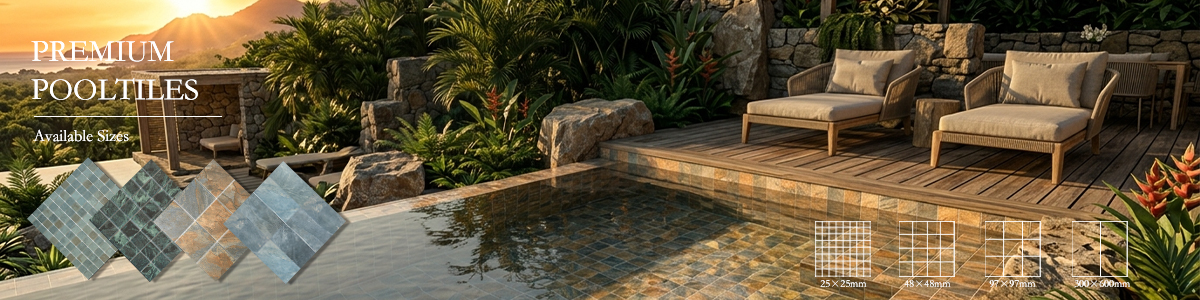
Shuangou ultimately used a mix of four different tones from the 300 × 600 mm “Samui Moss Stone” Series. The goal was not to deliberately create “four colors,” but to form a natural transition between different depths of tone. In the completed project, the pool bottom does not show strong blocks of separate colors. Instead, the interweaving tones create layered changes underwater, which are further softened when the water surface moves. The result is a body of water with variation but without visual disorder. This was the key point of the material combination: The mixed layout is not about adding more colors; it is about breaking the monotony of a large pool area.
Why Choose 300 × 600 mm “Samui Moss Stone” Pool Tiles?
The pool area is approximately 300 m². In a large indoor pool like this, tile size also affects the final visual result. If the module is too small, a dense network of grout lines can dominate the surface, while the designer wanted a more complete and calm body of water. The project therefore used the 300 × 600 mm “Samui Moss Stone” Series. The relatively large format gives the pool bottom a more expansive appearance, while the four colors still create staggered variation. For an indoor pool that emphasizes architectural quality and spatial integrity, it is not enough to ask whether a single tile looks good. You also need to consider the size of the space, the amount of grout, the frequency of color variation, and the overall first impression from outside the pool.
From Rendering to Real Installation, Shuangou Does More Than “Find a Tile”
The Xi’an Linxi Academy project also reflects an important way Shuangou now works with project partners: The designer first provides the intended spatial effect and design direction, and Shuangou then helps determine and coordinate the actual materials for the project. Rather than simply handing over a product catalog and asking the designer to choose a color, the process begins by understanding: What should the finished space feel like? What kind of water color should the pool have? Will a large-area installation feel monotonous? How should the proportions of different tile colors be arranged? How will the material change once it is placed in real water? The actual products are then matched to those questions. From the initial renderings, to selecting four 300 × 600 mm pool tiles, to completing the approximately 300 m² installation, this project ultimately proves one thing: Good material selection is not about finding the tile that looks most like the rendering; it is about finding a material solution that can truly turn the rendering into a real space.
For Pool-Tile Selection, What Really Matters Is “After It Is Installed”
When choosing pool tiles, many projects judge color mainly from a sample board. But for a pool covering several hundred square meters, Shuangou is more concerned with how the material performs once it becomes part of the entire space. Several factors need to be considered at the same time: Underwater color: a tile looks different once submerged than it does when dry; Large-area effect: a color that looks good on one tile may not work across 300 m²; Color proportion: mixing multiple colors does not mean dividing them equally; there must be hierarchy; Architectural relationship: the pool color must be judged together with the walls, ceiling, lighting, and stone; Final built result: the material is not chosen to look good on a sample rack, but to make the whole space work. This is what Shuangou has consistently focused on: Start with the material, but judge the final result by the space.
From the design rendering to the completed pool, the real value of the material is not that it “looks exactly like the rendering.” What matters is that when water, lighting, architecture, and materials are finally brought together, the feeling intended by the original design still holds true. Shuangou Ceramics does more than supply pool tiles; it continues to study the relationship between materials and space. From tile colors and sizes, to combinations of different tones, to real project implementation, the goal is not only to help designers answer “Which tile should I choose?” but also: “What will this material become when it is placed in my space? ”