
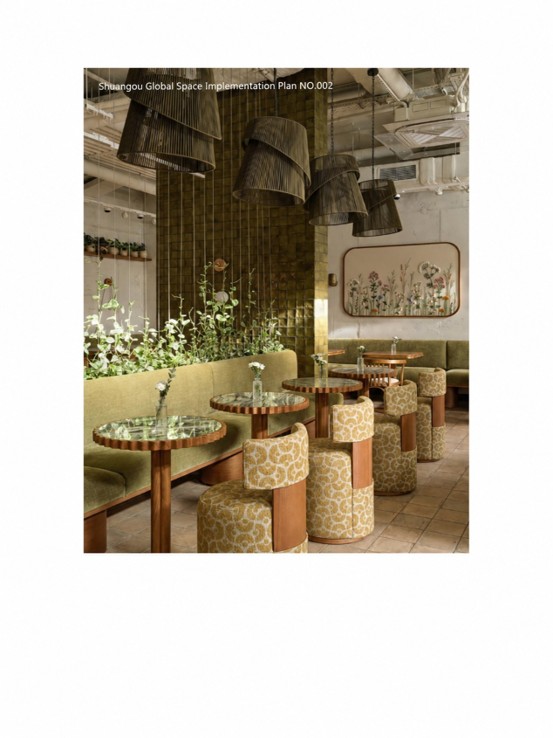
As commercial spaces place growing emphasis on experience, designers are turning their attention back to a material that is anything but “new” — small-format handmade tiles. They do not offer the seamless, pristine appearance of large-format slabs, nor do they try to hide grout joints. Instead, dense joint patterns, subtle color variation, and surface irregularities are becoming a way for cafés, restaurants, boutiques, and other spaces to create memorable visual identities.
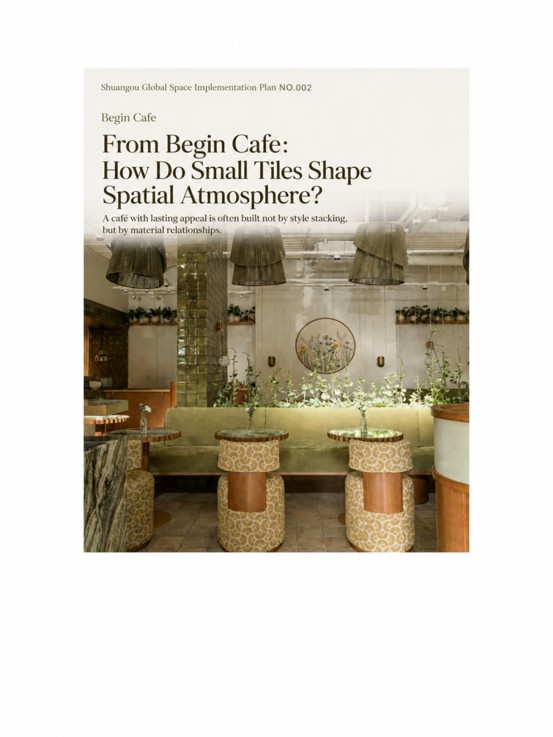
Begin Cafe in Kazan, Russia, is a representative example. Designed by Duplex Architectural Bureau and completed in 2024, the project covers about 90 m². Rather than starting from a predefined style, the design set out to create a “summer oasis” in the city, infused with memories of travel.
Why Is Begin Cafe So Memorable?
What makes Begin Cafe worth studying is not any single form or feature. The designers reorganized impressions from travel into the space: plant-covered streets, naturally faded colors, vintage furniture, handmade lighting, and tactile details come together to create a relaxed atmosphere that feels as though it has existed for years.
The project description also states that the design seeks to transform images of holiday neighborhoods and lingering travel memories into a spatial experience, allowing guests to feel something akin to being on a journey beyond simply dining. This is also what sets Begin Cafe apart from many “retro-style cafés.” It did not begin by defining a style and then selecting matching materials. Instead, it first defined how people should feel — and only then did the materials emerge.
Why Use Small-Format Handmade Tiles in the Space? The small green glazed tiles at Begin Cafe play an important visual role. The design notes specifically mention that the glossy green tiles on vertical surfaces shift in tone as the light changes, while the small square format introduces a subtle retro character. At the same time, the handmade-looking floor finish resembles outdoor paving, creating a feeling somewhere between an interior and a holiday street.
The value of the small tiles here is not simply that their “color is distinctive.” First, they change the perceived scale of the space. When a large wall is broken down into many small units, people no longer see one uninterrupted plane, but a collection of details that the eye can gradually read. Grout lines, edges, glaze, and subtle color differences all enter the visual field. This material language, closer to the human scale, can easily transform a commercial space from something that merely “looks complete” into something people want to approach and examine.
Second, there is light. Compared with a completely uniform surface, small glazed tiles produce subtle reflections as viewing angles and lighting change. The green is therefore not a fixed color swatch; it shifts throughout the day as the light changes. The material begins to participate in the space rather than simply serving as a background.
Why Are More Commercial Spaces Returning to Small-Format Materials?
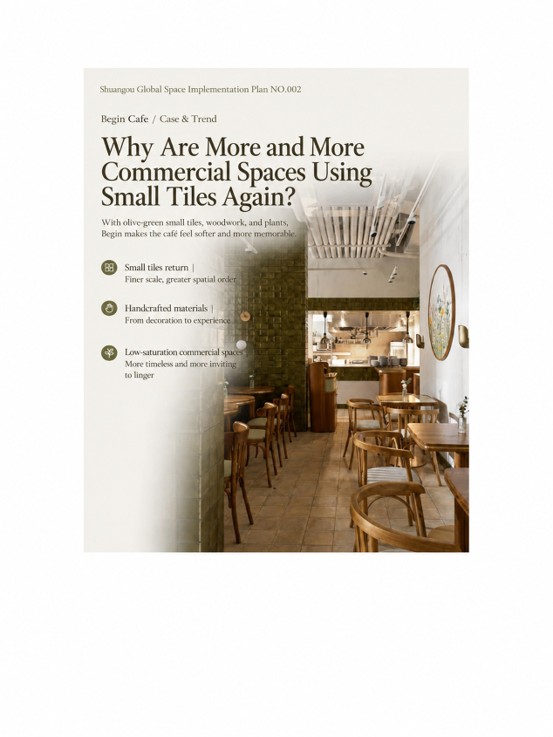
A clear shift is taking place in commercial interiors today: In the past, many stores pursued immediate visual impact. Now, more projects are asking a different question — once customers enter, will they want to stay? These two goals require different design logic. Strong forms, bold colors, and large installations can attract attention quickly. But to encourage people to stay longer, the tactile quality, scale, lighting, and relationship between materials and furniture often matter more. This is one reason small-format tiles are receiving renewed attention.
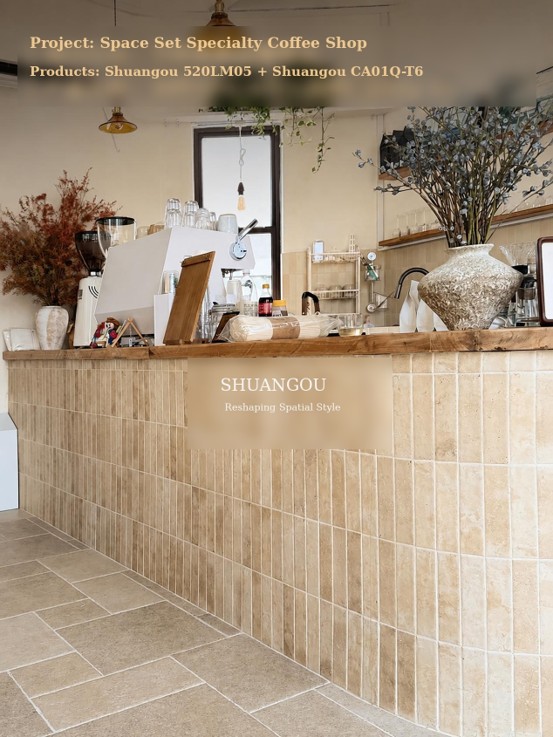
Dense grout lines create rhythm, while the subtle variation of handmade surfaces reduces the overly standardized feel common in commercial spaces. Combined with wood, textiles, mineral coatings, stone, and other materials, they can create richer tactile layers without making the space feel overly complex.
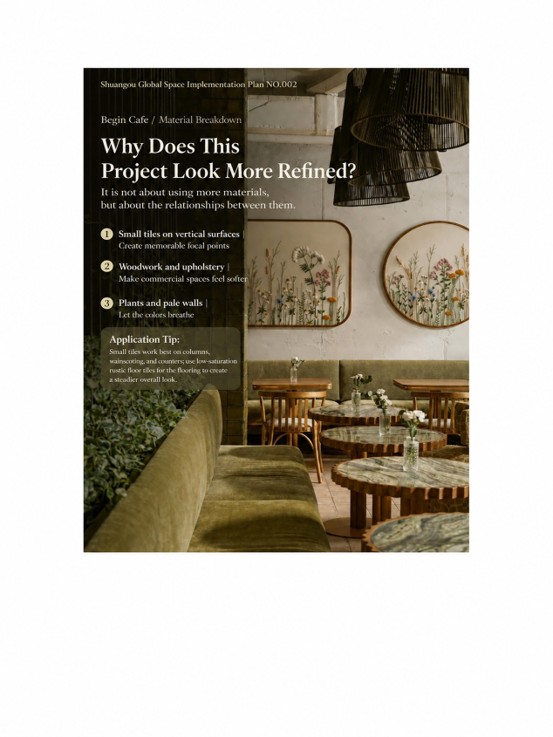
Begin Cafe offers a good example: the green small-format tiles do not stand alone, but appear together with wood, plants, textiles, stone, and warm lighting. So true sophistication has never been about simply “using small tiles.” It is about whether a coherent relationship between materials has been established.
What Should Commercial Spaces Really Learn from Handmade Tiles?
If Begin Cafe’s approach is applied to cafés, bakeries, or restaurants in China, the least advisable move would be to directly copy its green palette, arches, or furnishings. What is more valuable to translate are three principles.
- First, define the spatial mood before selecting materials. If the goal is a relaxed, natural atmosphere, materials with subtle color variation and a handmade quality can work well. If the desired mood is more restrained, overall saturation can be reduced and the tiles used as a localized visual anchor.
- Second, small tiles do not need to cover everything. Bars, columns, half-walls, banquette bases, and the inner surfaces of entrances — places people naturally approach — often show the advantages of small-format materials better than a fully tiled wall.
- Third, create relationships between materials. Glossy tiles can be paired with matte walls; finely divided small-format materials can contrast with more continuous woodwork or large-format flooring; cool stone can be balanced by warm wood for a more harmonious tactile experience.
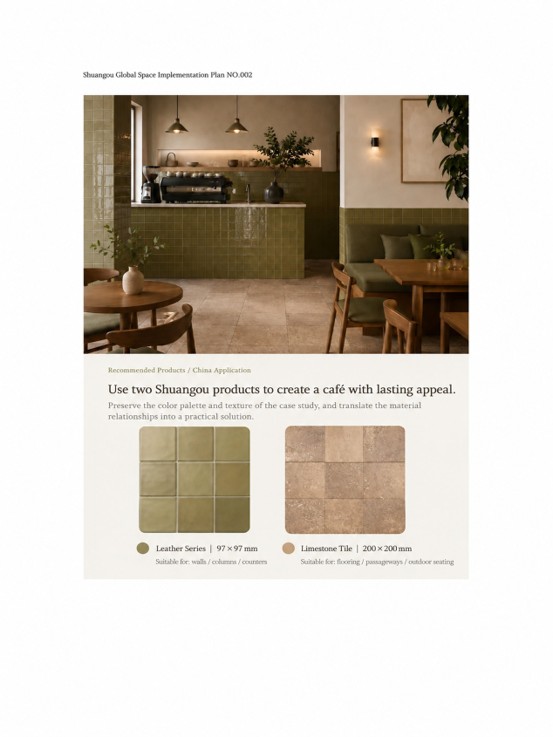
The key is not to increase the number of materials, but to control the scale, color, and tactile relationships between them. Can Chinese Materials Achieve a Similar Spatial Effect? Yes — but the answer should not be understood as finding a so-called “Begin Cafe matching tile.” For projects in China, a more sensible approach is to first break down the material language behind the case study: Low-saturation natural colors + small-format scale + handmade surfaces + localized glossy reflections + warm wood + soft lighting. Products can then be reselected according to the project’s actual size, target users, budget, construction conditions, and application areas.This is also what the “Shuangou Global Space Implementation Program” aims to do.
We study outstanding international interiors not to copy a foreign café, but to identify the material logic, scale relationships, and atmosphere-building methods that truly work — and then reinterpret them using materials that can be sourced, installed, and used long-term in China. From global case studies to implementation in Chinese spaces. Begin Cafe’s answer is actually simple: A space is often remembered not because one material is striking enough, but because the materials make an emotion visible. When tiles are no longer just a decorative surface, but begin to shape light, scale, touch, and the way people linger, they truly become part of spatial design.