
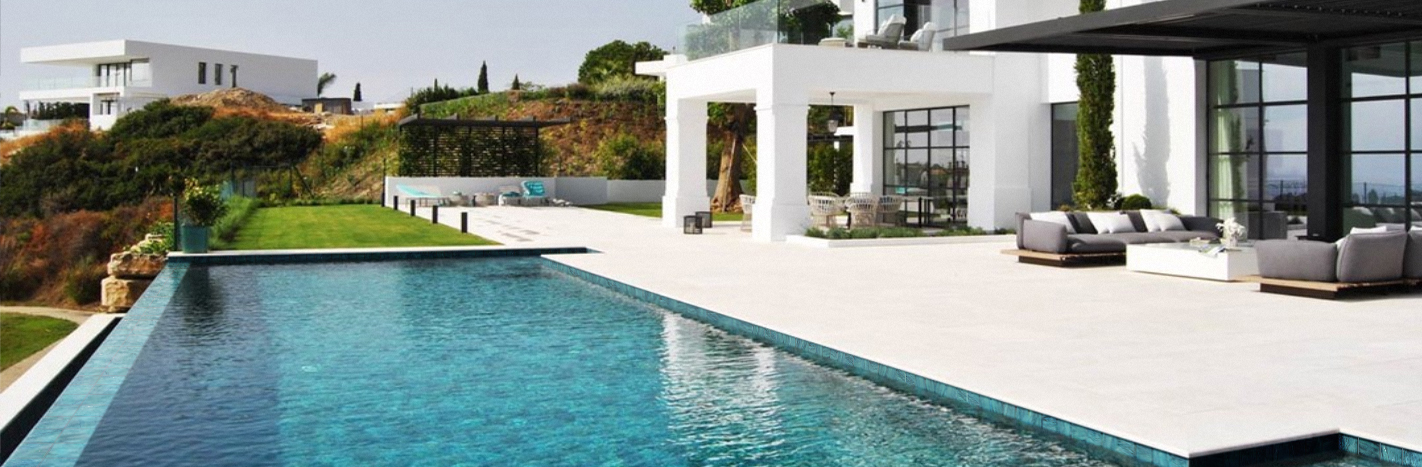
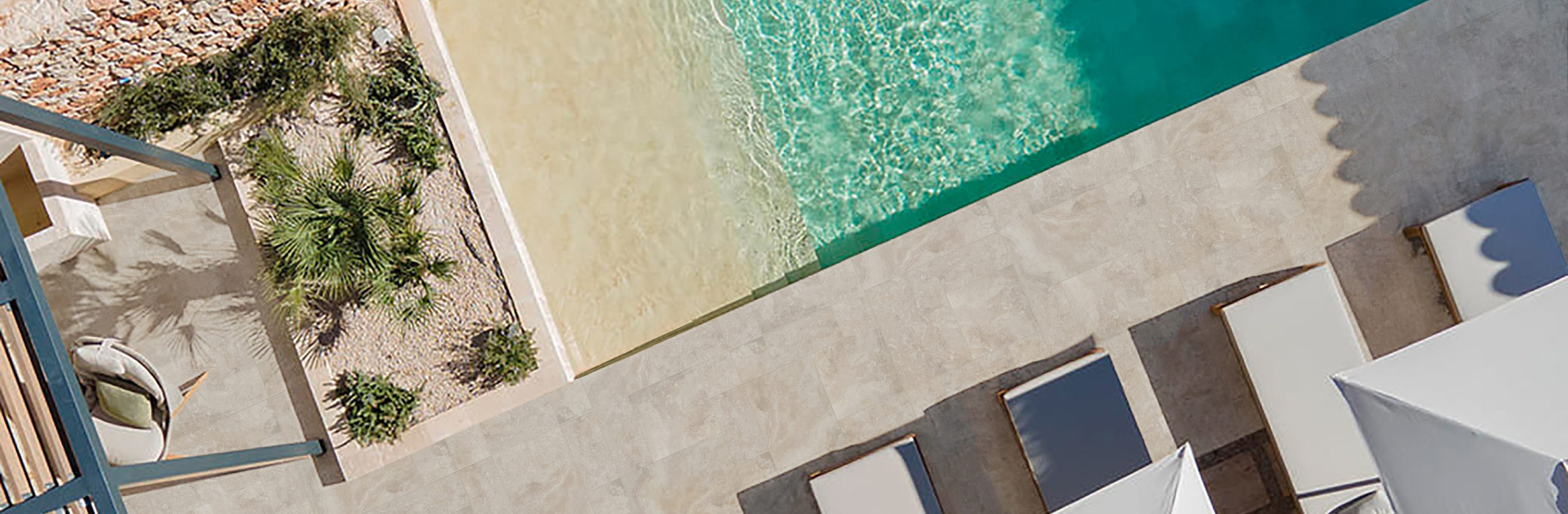
When architects design infinity pools in Ubud or cliffside resorts, the choice of premium swimming pool tiles dictates the entire look. The water in these spaces doesn’t have that sterile, bright artificial blue look you see in standard public pools. Instead, it glows with a deep emerald green or rich oceanic hue that blends right into the surrounding landscape. Replicating this “Bali Vibe” has become a massive trend, driving a global surge in sourcing swimming pool tiles that balance an exotic look with real-world structural durability.
The secret behind this trend comes down to the choice of swimming pool tiles. Specifically, it is the demand for premium natural stones native to Indonesia—most notably Green Sukabumi (a quartzite) and Black Lava Stone (Andesite/Basalt). These specific materials have taken over the luxury resort market. Buyers, commercial developers, and homeowners from Dubai to Miami are buying these textures to bring that tranquil, laid-back Balinese atmosphere to their own upscale projects. But trying to use real natural stone outside of Southeast Asia presents severe logistical and structural problems. True premium Sukabumi stone is a finite natural resource, quarried mostly in the West Java region of Indonesia. Shipping heavy raw stone across oceans involves massive freight costs. On top of that, keeping natural stone submerged in chemically treated pool water creates real engineering difficulties that many developers completely overlook.
To bridge the gap between design goals and real-world project viability, manufacturing companies have stepped in. Leading global manufacturers like ShuangOu Tiles analyze the exact mineral appearance of Bali’s iconic stones. By using modern production techniques, the industry can now deliver the exact visual depth of luxury swimming pool tiles in highly durable, low-maintenance porcelain solutions. This lets architects bring the look of a Balinese paradise to any global destination without the structural headaches of raw stone.
The Obsession with the “Bali Vibe”: What Makes These Swimming Pool Tiles Unique
The global demand for Balinese-inspired swimming pool tiles design is driven by a unique mix of precise mineral science and high-end luxury branding. To understand why international architects are willing to pay a premium to import this specific aesthetic, you have to look at how the material behaves under water and how it changes the feel of a commercial space.
The Science Behind the Color
The main material used in Balinese pool styling is Green Sukabumi stone tiles, which is a quartzite. This material interacts with water and sunlight differently than standard ceramic or generic slate.
When dry, raw Sukabumi stone looks like a muted, earthy-greyish green. But the moment it is completely submerged under water and hits the sunlight, an optical transformation occurs. The tile shifts into a rich, vibrant emerald green and deep Tiffany blue.
This color shift happens because of natural Zeolite within the rock matrix. Zeolite is a hydrous aluminum silicate mineral with a highly porous structure. While the natural Zeolite within the stone acts as a minor, passive purifying agent by absorbing trace impurities from the water, its primary commercial value is how it refracts light beneath the surface. It gives the pool an organic luster that mimics the natural hot springs of Ubud, creating a relaxed wellness environment.
Luxury Association and Global Adoption
Beyond raw mineral aesthetics, choosing a Bali-style pool design carries an association with top-tier luxury. Over the last two decades, international resort destinations have used this look as the standard for high-end properties.
From the overwater villas of the Maldives to private estates in Phuket, Thailand, and exclusive beach clubs across the Caribbean, green pools are consistently selected over traditional white or baby-blue plaster finishes. High-end boutique hotels leverage these pool aesthetics to justify premium nightly rates. Hospitality design reports show that an organic, resort-style pool is one of the top five features influencing guest booking decisions on travel platforms. The “Bali Vibe” immediately signals to travelers that a property offers a private sanctuary rather than a standard commercial experience.
For international developers looking to replicate this look without dealing with the logistics of sourcing raw Indonesian stone, understanding these precise color dynamics is essential. Brands like ShuangOu Tiles use these exact visual parameters—reproducing the precise color variations and organic shifts triggered by submerged Zeolite textures—to deliver premium porcelain alternatives that meet the standards of luxury hospitality design.
The Hidden Challenges of Using Real Natural Bali Stone in Global Projects
While authentic Indonesian rock looks incredible, importing raw natural stone for projects outside of Southeast Asia introduces severe technical, logistical, and financial obstacles. For architects, contractors, and estate owners, specifying raw natural stone pool tiles frequently results in unexpected long-term liabilities that complicate both the construction phase and ongoing swimming pool tiles maintenance.
These engineering and logistical realities are critical to understand before breaking ground on any premium pool project.
1. High Logistics Costs and Carbon Footprint
Raw volcanic and metamorphic stones, such as Green Sukabumi quartzite or Andesite black lava stone, are incredibly heavy, dense materials. Because these stones are quarried in specific localized regions like West Java, Indonesia, transporting them to major construction hubs in Europe, North America, or the Middle East requires complex international shipping.
Freight forwarding fees, customs duties, and specialized overland transport often end up doubling or tripling the initial factory cost of the material itself. In modern commercial architecture, green building certifications (such as LEED or BREEAM) heavily penalize the high embodied carbon associated with shipping thousands of kilograms of raw, unrefined stone across oceans.
2. Water Absorption and Chemical Vulnerability
From a structural engineering standpoint, the greatest weakness of raw natural stone is its inherent porosity. Unlike manufactured materials, natural stone features microscopic voids and fissures.
Natural Sukabumi and lava stones generally have a water absorption rate ranging from 1.5% to over 3%. When continuously submerged in pool water, this porosity leads to water logging. Over time, the moisture pulls soluble salts from the setting mortar up through the stone, resulting in white, powdery staining on the pool surface known as efflorescence. Furthermore, these microscopic pores act as perfect breeding grounds for organic matter, leading to rapid algae buildup that turns the pool surfaces slippery and unhygienic.
Modern swimming pools rely on aggressive sanitation systems, including chlorine, acid washes, and salt-chlorine generators. Raw stones are highly susceptible to chemical erosion. Constant exposure to these pool chemicals gradually leaches out the natural minerals, causing the stone to fade, disintegrate, or pit over time.
For luxury projects located in regions with cold winter climates—such as the Northern United States, Canada, or Central Europe—high water absorption is fatal. Water trapped inside the porous stone expands when it freezes, triggering internal stress that causes the tiles to crack, spall, or completely detach from the pool shell.
3. Post-Installation Maintenance Overhead
Many homeowners and resort operators select natural stone without realizing that its pristine appearance requires an aggressive, permanent maintenance schedule.
To reduce water absorption and chemical staining, natural stone pool tiles must be treated with a specialized, breathable penetrating sealer immediately after installation, and subsequently resealed every 1 to 2 years. Resealing a commercial or residential pool is a labor-intensive process. It requires completely draining the pool, letting the surfaces dry thoroughly, applying chemical sealers, and waiting for them to cure before refilling. For boutique hotels and resorts, this periodic maintenance translates directly to costly operational downtime and lost booking revenue. If this maintenance cycle is neglected, the stone quickly loses its color luster, accumulates stubborn mineral scaling, and becomes slick underfoot.
Changing the Approach to Pool Engineering
Because of these recurring engineering issues, pool designers are shifting away from raw, unrefined geological materials. The modern international standard for high-end aquatic design favors advanced material alternatives.
By analyzing these structural paint points, specialized manufacturers like ShuangOu Tiles have engineered porcelain-based pool tile collections that perfectly mirror the aesthetics of Balinese stones, while completely eliminating the structural liabilities of water absorption, chemical degradation, and high-frequency maintenance.
Why Choose Porcelain Swimming Pool Tiles to Replicate the Bali Stone Look
The logistical and structural limitations of natural stone have paved the way for an engineering breakthrough in the luxury pool market. To allow international developers, architects, and homeowners to capture the iconic Balinese resort aesthetic without the prohibitive costs or technical liabilities of raw stone, ShuangOu Tiles has introduced a pioneering alternative: the Bali Stone Look Porcelain Swimming Pool Tiles series.
By merging high-definition surface engineering with industrial vitrified tile manufacturing, ShuangOu provides a definitive, worry-free solution that makes premium tropical pool design accessible to projects anywhere in the world.
1:1 Aesthetic Replication of Bali Natural Stones
Replicating the visual depth of natural Indonesian stone without its high maintenance requires sophisticated surface engineering. ShuangOu’s Bali-style porcelain swimming pool tiles utilize advanced 3D inkjet digital printing coupled with specialized surface crystallization techniques. This technology flawlessly captures the cool green undertones of raw Sukabumi quartzite and the deep charcoal textures of Balinese Andesite lava stone.
The collection replicates the signature cool, soothing green undertones of raw Sukabumi, as well as the deep charcoal, micro-porous volcanic textures of classic Balinese Andesite and Lava stone.
In standard tile manufacturing, repetitive patterns ruin the natural illusion. ShuangOu overcomes this by engineering dozens of unique, non-repeating tile faces within a single production run. According to the international tile shading classification system established by the Tile Council of North America (TCNA), this delivers a controlled V2 (Slight Variation) to V3 (Moderate Variation) vitrified color variation. When fully installed and submerged, these intentional color variations interact with sunlight and moving water to create the exact, non-uniform patchwork texture found in six-star Balinese luxury resorts.
Engineering Specifications and Dimensions
Beyond its appearance, the structural design of these porcelain tiles is tailored directly to the practical demands of aquatic architecture and commercial pool installation.
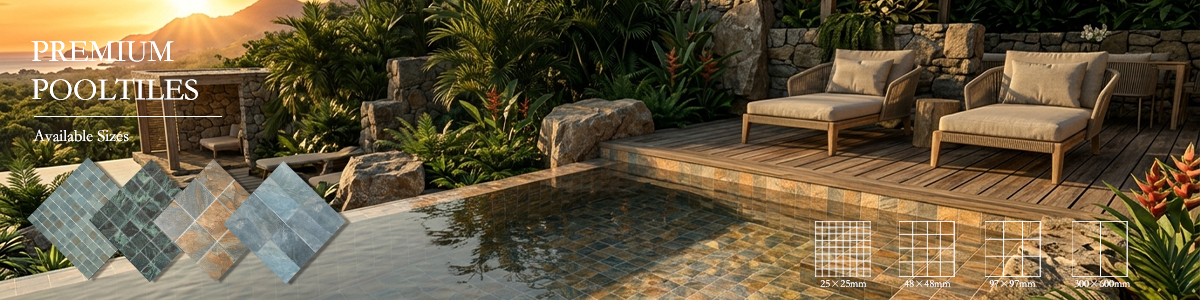
ShuangOu offers these premium collections in classic, highly demanded pool dimensions, including 10×10 cm (4×4 inches) and 20×20 cm (8×8 inches) small-format square tiles. These smaller sizes are highly favored by pool engineering contractors because they easily conform to complex architectural geometries, such as curved pool steps, sloped transition floors, and custom infinity edges. Furthermore, utilizing these traditional dimensions allows designers to create classic mosaic-style transitions, ensuring that the finished pool looks authentic down to the millimeter.
By choosing ShuangOu Tiles as a strategic supply partner, global procurement managers eliminate the unpredictability of international raw stone shipping, drastically reduce initial material outlays, and guarantee that their project achieves a clean, world-class resort finish that remains structurally sound for decades.
Engineering Comparison: Natural Bali Stone vs ShuangOu Porcelain Tiles
When selecting the best swimming pool tiles for international resort developments or high-end residential estates, aesthetic appeal must always be backed by rigorous engineering metrics. While raw geological materials look stunning in tropical climates under local conditions, a side-by-side technical evaluation reveals why advanced porcelain engineering is rapidly replacing raw stone as the global industry benchmark.
To help architects, landscape designers, and commercial pool contractors make data-driven decisions, the following technical performance matrix outlines the critical engineering specifications of raw Indonesian stone against ShuangOu high-performance porcelain swimming pool tiles, helping commercial contractors make data-driven procurement decisions.
Technical Performance Matrix
| Performance Features | Natural Bali Stone (Raw Green Sukabumi) | ShuangOu Bali-Style Porcelain Tiles |
|---|---|---|
| Water Absorption Rate | High (>2.0% – 5.0%) The naturally porous mineral structure absorbs massive amounts of moisture, triggering internal pressure, mineral leaching, and rapid algae buildup or bacterial colonization within the tile joints. | Ultra-Low (<0.5%) Fully vitrified under extreme manufacturing temperatures. The dense molecular structure completely blocks water ingress, permanently eliminating efflorescence (salt damp) and sub-surface staining. |
| Frost & Freeze-Thaw Resistance | Poor / Volatile Trapped moisture inside the stone expands rapidly when exposed to temperatures below 0°C. This causes severe micro-cracking, surface spalling, and sudden structural delamination in cold winter climates. | Excellent / Fully Frost-Proof Engineered to withstand extreme thermal shock and deep-freeze cycles without cracking, peeling, or degrading, making it ideal for Northern environments. |
| Chemical & Corrosion Resistance | Low / Prone to Fading Highly vulnerable to continuous exposure to pool chemicals, including concentrated chlorine, shock treatments, acid washes, and saltwater systems. Minerals gradually leach out, causing surface pitting and severe discoloration. | Class UA / Maximum Resistance Completely immune to pool sanitation agents, chlorine, acids, and salt chlorination systems. The vitrified glaze prevents any chemical bonding, ensuring zero fading or surface degradation over time. |
| Slip Resistance Rating | Unstable / Variable Relies entirely on mechanical raw surface finishes (such as honed or rough-sawn). Over years of constant pedestrian traffic and water erosion, the texture wears down and becomes dangerously slick. | Stable R11 / Class C Rating Engineered with a permanent, anti-slip micro-texture that maintains a certified R11 slip rating. Provides maximum safety and grip for bare feet on wet pool decks and steps without wearing away. |
| Long-Term Post-Installation Maintenance | High Overhead Cost Requires strict, labor-intensive professional cleaning and penetrating chemical sealing every 1 to 2 years to combat water logs and algae, resulting in recurring facility downtime. | Zero Maintenance Overhead Requires no post-installation sealers or special chemical treatments. Standard routine cleanings with fresh water keep the surface pristine and functional for a lifetime of up to 50 years. |
Engineering Feasibility for Large-Scale Commercial Pool Tiles
Beyond environmental ethics, international commercial projects demand rigorous operational feasibility. When managing major developments—such as commercial water parks, municipal aquatic centers, or sprawling international resort chains—relying on raw stone introduces massive supply chain risks.
- Batch Consistency and Color Matching: Natural stone quarried at different times or from different veins can vary wildly in tone and structural soundness. ShuangOu engineered commercial pool tiles eliminate this unpredictability by delivering absolute color batch consistency across tens of thousands of square meters, ensuring a unified aesthetic across massive project footprints.
- Stable Production and Accelerated Timelines: Unlike artisanal stone quarries that are vulnerable to seasonal monsoon delays and limited extraction limits, ShuangOu’s automated industrial manufacturing lines guarantee stable capacity and predictable production schedules.
- Strict Quality Compliance: Every manufacturing run complies fully with international product standards (such as ISO 13006). This gives global architects and commercial contractors total peace of mind regarding structural load tolerances, dimension accuracy, and structural integrity under heavy public foot traffic.
Conclusion
The global fascination with Balinese pool styling is ultimately a pursuit of wellness, natural harmony, and premium lifestyle design. The tranquil emerald water and deep volcanic tones that define the world’s most elite resorts do not have to be bound to a single geographic location, nor do they require the high operational liabilities of raw, porous geological materials.
Through innovative material science, ShuangOu Tiles has successfully bridged the gap between natural design inspiration and high-performance engineering. By overcoming the limitations of water absorption, chemical degradation, and high logistics costs, you can now seamlessly install the pure, untamed luxury of a Balinese paradise into any commercial destination worldwide.