
Introduction
A modern pool renovation isn’t just about patching up old leaks anymore. It’s a major architectural upgrade. Property owners and landscape architects are using renovations to pair high-end design with smart material science, turning aging pools into low-maintenance assets that actually build property value. If you want your renovation to last, you have to understand how different materials handle water, weather, and chemicals. Traditional finishes—especially standard plaster, cheap local stone, and painted coatings—are notorious for breaking down in treated pool water. Give it a few years of constant exposure to chlorine, automated salt-chlorine generators, acids, and heavy UV radiation, and the surface ruins. You end up with cracking, eroded aggregate, white chalky buildup (efflorescence), scaling, and deep black algae that you can’t scrub away without a destructive acid wash. Worse yet, winter freeze-thaw cycles push water into porous materials, causing regular tiles to crack, pop right off, and ruin the pool’s concrete shell.
To avoid these headaches, modern engineering points straight to specialized, high-firing ceramics. That’s where ShuangOu Tiles comes in. As a dedicated manufacturer of industrial-grade and boutique swimming pool ceramics, ShuangOu uses advanced material science to build porcelain and glass tiles with a water absorption rate under 0.1%. By firing these products at temperatures over 1200°C, they achieve complete vitrification. This completely locks out moisture, chemicals, and algae spores. For a pool renovation in 2026, these materials meet the industry’s toughest durability and design standards, ensuring your backyard project stays intact and looks incredible for decades.
Porcelain vs Glass Mosaics for Your Pool Renovation
When you’re planning a pool renovation, choosing the right material for each part of the pool is the best way to balance your budget with long-term performance. Architects generally look at two main choices: porcelain tiles and glass mosaics. Both last vastly longer than old-school plaster or aggregate finishes, but they have different strengths and belong in different parts of the pool.
| Technical Performance Attribute | Porcelain Swimming Pool Tiles | Premium Glass Mosaics |
|---|---|---|
| Primary Chemical Composition | High-purity kaolin clay, quartz, and feldspar minerals fired at 1200°C+ | Super-heated silica sand fused with metal oxides and iridescent compounds |
| Water Absorption Rate (ISO 10545-3) | Ultra-low (Typically < 0.1% or < 0.05%) | Absolute Zero (0.00%) – Completely non-porous structure |
| Optimal Installation Zones | Main pool floor & walls, waterlines, beach entries, coping, pool decks | Waterlines, submerged benches, spa interiors, feature walls, step markers |
| Slip-Resistance Capabilities | Highly customizable textures achieving R11, R12, and Pendulum Class C | Relies purely on high-frequency grout joints for physical traction |
| Thermal Shock Resistance | Excellent – Structural matrices resist extreme freeze-thaw cycles | High – Requires specialized expansion joints and flexible thin-set |
| Mechanical Bonding Efficiency | Superior – Textured or porous backings maximize mortar adhesion | Requires specialized polyurethane or epoxy-bonded mesh backings |
| Average Operational Lifespan | 30+ Years with correct polymer-modified grouts | 30+ Years when protected from direct hard impact damage |
I can’t emphasize this enough: off-the-shelf indoor wall or floor tiles are useless for a pool renovation. Interior tiles are fired at lower temperatures, meaning the clay body stays porous. If you submerge them, they drink up pool water through capillary action. Then, the pool chemicals and salt ions break down the bond between the tile and its glaze, causing the surface to peel and crack. When winter hits, that trapped water expands by about 9%, creating internal pressure that shatters the tile from the inside out.
ShuangOu Tiles avoids this by manufacturing its swimming pool porcelain collections under high hydraulic pressure and strict temperature profiles. This process vitrifies the raw minerals, turning the clay into a dense, crystalline structure. In chemical resistance testing (ISO 10545-13), ShuangOu tiles prove completely immune to household chemicals, sanitizing agents, and salt-chlorine systems. The material is simply too dense for water to penetrate, which makes it completely frost-proof even during brutal temperature swings.
Critical Areas to Upgrade During a Pool Renovation
A smart pool renovation doesn’t treat the whole pool as one uniform surface. Different zones deal with different types of wear and tear. Upgrading these specific areas with targeted material solutions from ShuangOu Tiles protects your investment and keeps things safe.
The Waterline Tile: Your Critical Line of Defense
The waterline—the top 6 inches of the pool where air and water meet—takes a beating. It deals with constant UV rays, concentrated chemicals, body oils, and organic debris. Plus, as water evaporates, calcium deposits leave hard, ugly scale lines here.
Modern designs favor upgrading to larger 6×6-inch or 3×6-inch through-body porcelain tiles rather than tiny traditional mosaics for two simple reasons:
- 80% Fewer Grout Lines: Cutting down on exposed grout means fewer places for algae and scale to take root.
- Easy Maintenance: ShuangOu’s waterline porcelain features a smooth, dense vitrified glaze. Calcium can’t get a mechanical grip on it, so you can wipe away scale and oils without resorting to heavy acid washing.
Tanning Ledges and Baja Shelves — Maximizing Safety and Comfort
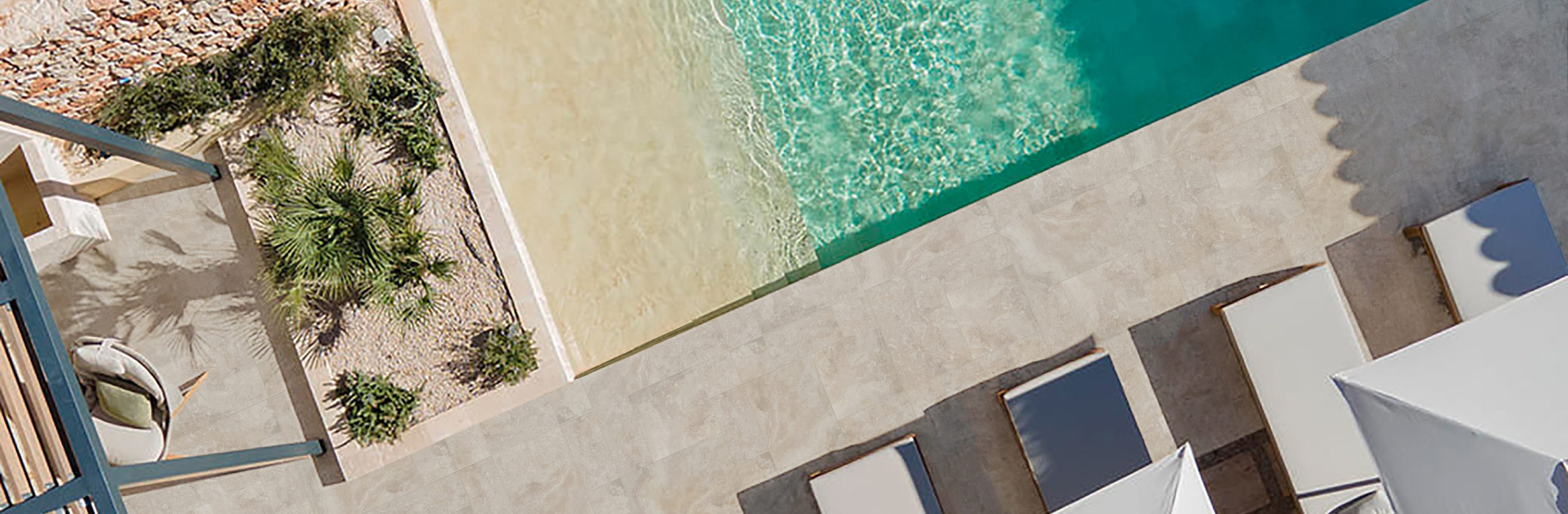
Data from the Master Pools Guild shows that over 78% of high-end pool renovations over the last two years included a tanning ledge, also called a Baja shelf, sun shelf, or shallow thermal ledge. These shallow, submerged platforms sit under just 6 to 12 inches of water, making them perfect for lounge chairs, umbrellas, or a safe place for kids and pets to splash. But because they sit right under the surface, the sun warms the water fast. This burns through chlorine quickly, creating a micro-environment where a thin, slippery layer of algae or biofilm can grow. That invisible film makes the surface incredibly slick, creating a real fall hazard for anyone stepping onto the platform.
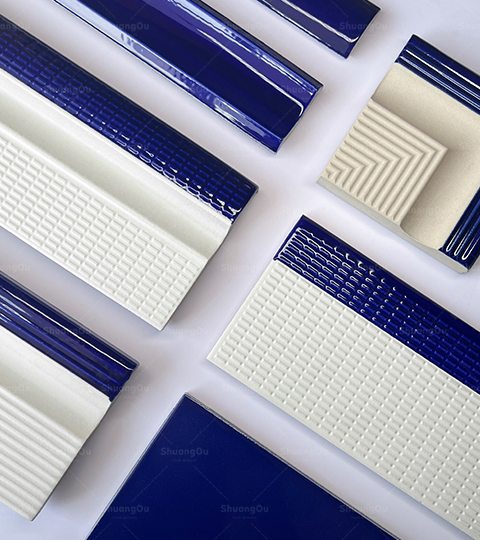
To fix this risk, certified slip-resistant ceramics are necessary for a professional pool renovation. ShuangOu Tiles makes specialized anti-slip porcelain tiles that meet the highest international safety standards, including the European R11 standard and the German A+B+C wet-barefoot slip-resistance certification. Instead of using rough, sand-like grit in the glaze—which scrapes bare feet and wears off over time—ShuangOu shapes the surface mold and uses a micro-textured glaze. It provides great traction under a wet foot while remaining smooth and comfortable to walk on.
Pool Coping and Decking — Executing the Seamless Visual Transition
The coping is the stone or tile capping mounted on top of the pool wall. It is the primary handhold for swimmers and divides the pool from the deck. In the past, builders often mixed unrelated materials, like basic interior tiles with rough poured concrete coping or natural flagstone. It broke up the look of the yard and caused structural problems; natural stone coping often contains iron that leaks out when splashed, leaving permanent rust stains on the deck.
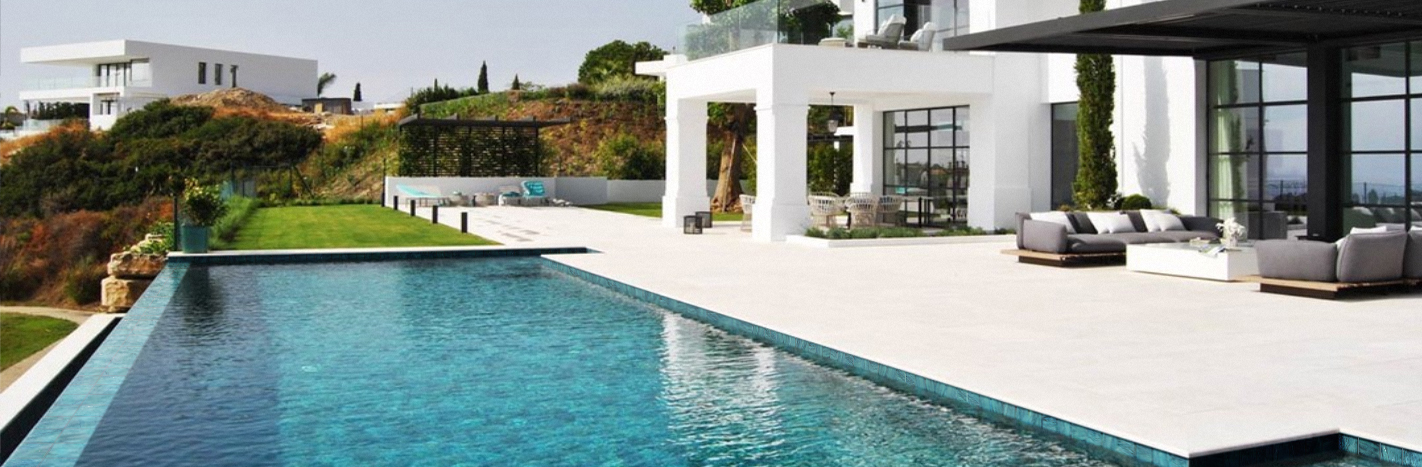
Modern design rejects that choppy look. Instead, the focus is on a clean, continuous style often called the “Seamless Indoor-Outdoor Transition.” To get this effect, designers use ShuangOu’s 2CM (20mm) exterior porcelain pavers and matching bullnose coping profiles for the entire pool surround. These thick porcelain pavers match the color and style of the interior waterline tiles exactly, letting the design flow from the patio, right over the edge, and down into the water. With a breaking strength over 10,000 Newtons, these pavers handle heavy outdoor furniture easily while resisting salt corrosion, frost, and cracking.
Why ShuangOu Tiles is Your Trusted Partner for 2026 Pool Renovations
Managing a pool renovation means finding materials from a manufacturer you can trust. ShuangOu Tiles tests every single production run to ensure it meets European CE markings, ISO 9001 quality standards, and American National Standards Institute (ANSI) specifications for underwater tile installations. This checking stops common factory defects like warping, size variations, and tiny cracks that make installation difficult and cause leaks down the road.
You can see how ShuangOu products perform in commercial and residential projects worldwide. They are used in high-traffic Olympic-size competition pools that need exact sizes and chemical resistance against automatic dosing systems, as well as infinity-edge resort pools exposed to salt and heavy sun. This experience means the tiles are easy to cut, simple to set, and work perfectly with modern epoxy and polymer-modified mortars.
ShuangOu Tiles also fits into the current focus on green building certification. Because construction and renovation projects face stricter carbon limits, picking eco-friendly materials matters to architects and developers. ShuangOu addresses this by recycling water in its factories, sourcing clay from local quarries, and using energy-efficient natural gas kilns to cut emissions. Because porcelain lasts so long, a single installation removes the need to resurface the pool every 7 to 10 years, lowering the lifetime environmental impact of the property.
Conclusion
A pool renovation in 2026 is your chance to improve the value, safety, and look of your property. Moving away from short-lived plaster and porous stone toward advanced ceramics protects your investment from underwater wear. Whether you want the deep reflections of the “Mirror Effect” using midnight porcelain, the look of biophilic simulated stone textures, or the shimmer of iridescent glass mosaics, picking the right material grade is the single most important decision in the process.
ShuangOu Tiles provides the porcelain tiles, anti-slip surfaces, and glass mosaics needed for a complete pool project. Don’t risk your renovation on lower-tier residential materials that break down after a few seasons. To plan a low-maintenance outdoor space, contact the technical engineering team at ShuangOu Tiles to look through their collections, discuss project details, or ask for professional sample kits.