

Materials are not just surface decoration for a space — they are a vital medium that shapes water color, ambiance, and user experience. In recent years, pool design in high-end residential and commercial projects has undergone a noticeable shift: pools are no longer merely functional amenities, but are gradually becoming the most emotionally resonant part of a space.
Water Color Is Redefining the Character Direction of Pools
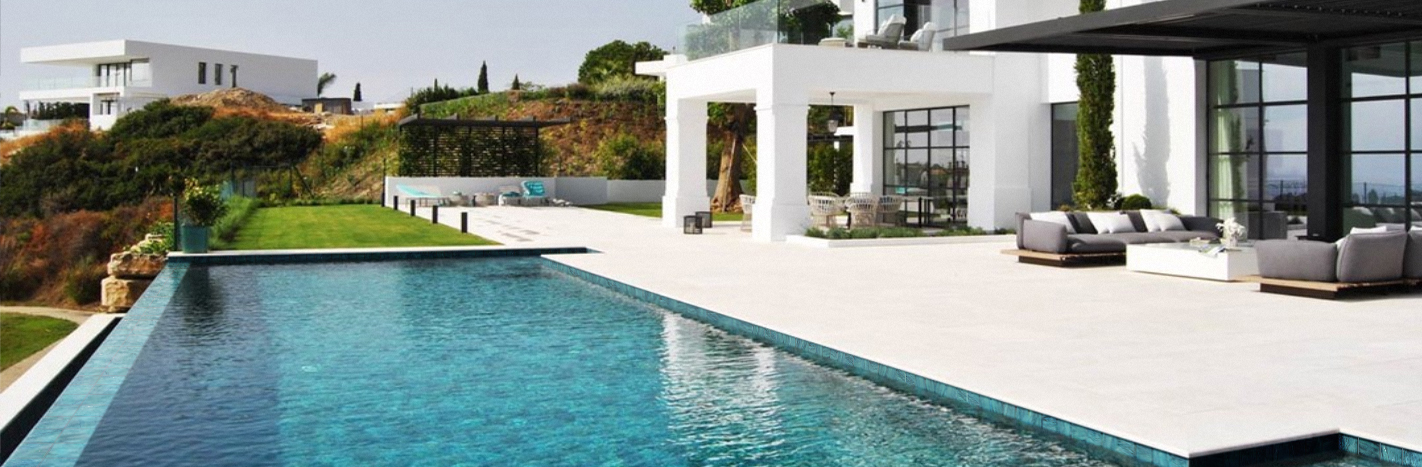
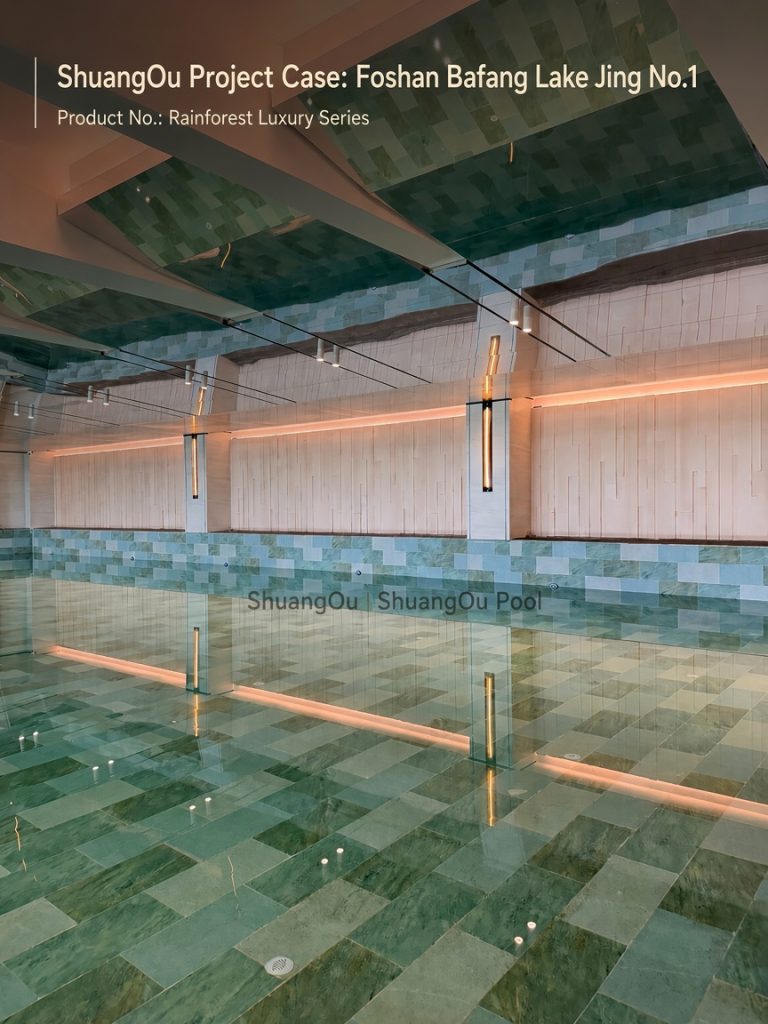
Traditional pools have long been dominated by blue. Blue is directly associated with coolness and cleanliness, but it can also easily give a space a strong public sports facility feel. The pool at Bafang Hujing No.1 has taken a completely different direction: using gray-green water as the visual core, paired with warm-white architectural surfaces and linear lighting, giving the entire pool area an atmosphere closer to a boutique hotel or private club. The advantage of gray-green water is that it integrates more easily with the overall architectural character. A blue pool often becomes an isolated visual island within the space, whereas gray-green naturally bridges warm-white stone, wood finishes, and warm lighting systems — the pool is no longer an isolated blue zone. At the same time, green naturally evokes associations with forests, lakes, and mossy environments, and once submerged, it further softens the artificial feel.
Shuangou Ceramics’ Rainforest Luxury Series is precisely a product line developed around this water color trend. Drawing color inspiration from rainforests, moss, moist rock formations, and natural minerals, it integrates mist green, gray-green, light moss green, forest green, and deep mineral green into a single material system, preserving the textural variation and color layering reminiscent of natural stone. When selecting pool tiles, the relationship between water color and the overall architectural palette matters far more than the individual tile color.
There is a common cognitive bias when selecting pool tiles: in the showroom, samples are dry and illuminated by spotlights. Once laid on the pool floor and filled with water, light refraction within the water body will make the same tile appear with a completely different hue and textural depth. Light gray-green areas make the water appear clearer and more transparent, deep green veining enhances underwater layering, and natural color variation reduces the mechanical, grid-like feel of large-area installation. Shuangou Ceramics, in its pool tile R&D, does not only look at the dry-state color of individual samples — it focuses more on the combined result of the material entering water and interacting with light, scale, and architecture. This observation method — shifting from “dry display board” to “underwater reality” — is a valuable reference for any project selecting pool tiles. Whenever possible, after obtaining samples, try soaking them briefly in shallow water to observe color changes — the result is often very different from dry-state judgment.
Pool Floor, Pool Walls, and Ceiling Reflections — Material Language Must Be Unified
The Rainforest Luxury Series used in the Bafang Hujing No.1 pool is not only laid on the pool floor but also extends to the pool walls and underwater interfaces. Using the same color system on both floor and walls reduces the sense of fragmentation at underwater interfaces, making the water color more complete and the pool boundaries appear more natural. The mirrored ceiling structure above reflects the green pool floor materials and water imagery upward — real material and mirrored reflection form an upper-lower echo, with the material language realized through water and light, rather than through complex decorative forms. The insight for pool tile selection here is: when selecting tiles, don’t just consider what color the pool floor needs — simultaneously consider whether the pool walls, steps, shallow areas, and overflow channels use materials within the same color system. If there is a color-temperature break between different areas, the reflections on the water surface will amplify this flaw.
The Balance Between Warm Light and Green Ambiance
Water, mirrors, and green materials lean cool overall. If paired with high-color-temperature cool white light, indoor pools can easily feel harsh. Bafang Hujing No.1 balances the warm-cool relationship of the space through warm-colored linear light strips — the lighting is concealed between the pool edge and walls, creating ambiance through indirect illumination. Warm light, after multiple reflections off the water surface and mirrors, makes the pool tiles appear more warm and delicately textured. The project’s approach to lighting-material coordination is worth learning from: the Rainforest Luxury Series establishes natural water color, warm lighting provides emotional temperature, warm-white walls complete the color transition, and mirrors amplify the layering of water and materials. What ultimately appears is not the effect of a single material, but the result of a material system and lighting system working together.双鸥
Conclusion
From the Bafang Hujing No.1 case, it’s clear that the value of pool tiles has long gone beyond merely meeting waterproofing and anti-slip functional requirements. Water color selection determines the character positioning of the pool, the actual underwater performance of materials determines the layering of the water body, multi-format combinations influence the visual rhythm of large-area installation, and the material unity between pool floor, walls, and ceiling reflections determines the spatial integrity.


